WE DO MORE THAN LIFT KITS.
This page is proof. Iron Ridge is a full-service off-road build facility — armor, drivetrain, electrical, fabrication, audio, and everything in between. Every category below is real capability in-house, not a vendor we subcontract to.
What We Build, Install, & Fabricate
Seven core categories. One shop. Every service below is performed in-house by the same crew that does our lift kits — not shipped to a partner, not subcontracted out. Below is a deep look at the work we do, the platforms we do it on, and how each category integrates with the rest of your build.
Why Houston Drivers Choose a Full-Service Build Shop
The biggest reason builds go sideways isn't a bad part — it's shop-hopping. Here's what actually happens when one shop builds the whole truck, and why it's a different experience than visiting three or four specialists.
One Warranty. One Phone Number.
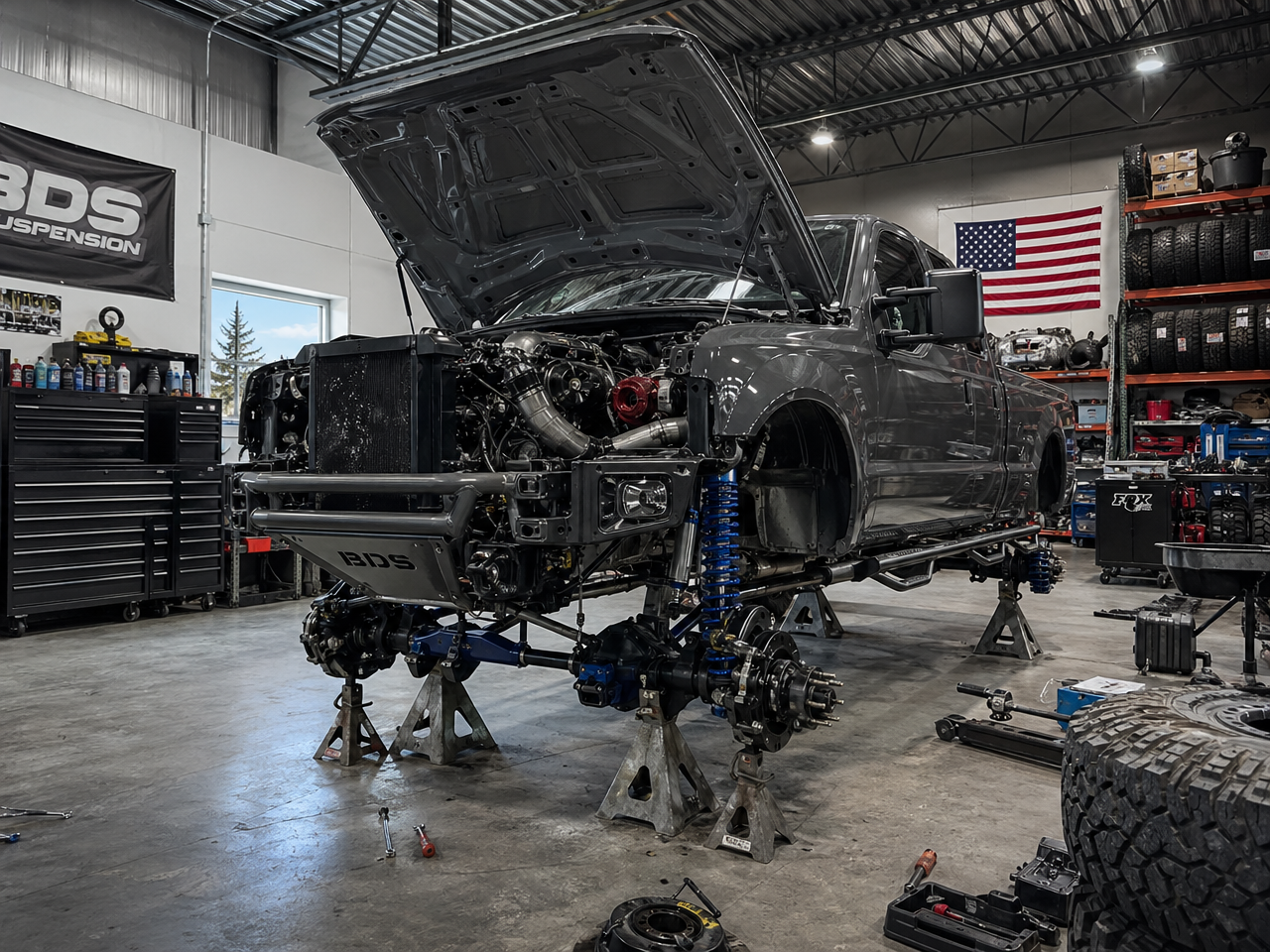
When four different shops touched the same truck, nobody owns the result. Alignment shop blames the lift shop; lift shop blames the tire shop; audio shop blames "whoever pulled the dash last." Here, every component on the truck was installed by the same crew under the same warranty. If something isn't right after you drive away, there's exactly one phone number to call, and there's no finger-pointing between vendors.
Build Cohesion From Day One
Lift height affects tire size, which affects gearing, which affects brake spec, which affects wheel offset, which affects fender clearance, which affects armor mounting. A shop that touches all of those at once catches conflicts before they cost you money. Shop-hopping catches them after — usually when the truck is already apart and the parts are already paid for.
Fewer Trips, Less Downtime
When the suspension shop finishes Tuesday, the truck goes home. When the tire shop wants it Thursday, it goes back. When the fab shop calls Friday to say the sliders arrived, it goes back again. Each round trip costs you a morning off work. A full-service build does lift, tires, alignment, armor, and wiring on one work order and one visit — often with a single scheduled downtime window.
Documented End to End
Every build that leaves our shop has a written spec sheet: what parts went on, what torque values were used on critical fasteners, what gear ratio was set, what alignment numbers were achieved, what the SWR reading was on any radio install. You get the document. The truck gets a copy on file. If you sell it later, that record is resale value. If you come back in three years for a re-gear, we already know what's on the truck.
Texas-Specific Expertise
Houston builds face different problems than Arizona, California, or Colorado builds. Our rain and humidity destroy bare copper connections, our tropical storms flood electrical, our summer heat kills rubber isolators and exhaust hangers in months, and our ranch country and Piney Woods are harder on armor than most of the country. We build with those conditions in mind by default — not as an add-on.
Real In-House Fab, Not a Markup
Many shops say "we fabricate" but really mean they farm it out. We cut, bend, weld, and finish in the same building where we install. That means custom solutions get turned around in days, not weeks, and that anything one-off we design for you gets a real fitment test before it's ever attached to your truck.
From Consult to Handoff: Our 5-Step Build Process
Every build — from a simple skid plate install to a full ground-up overland conversion — follows the same five-step process. This is the process that keeps quotes accurate, timelines honest, and the finished truck built the way you actually wanted it built.
You bring the truck. We walk it together. We ask how you actually drive it, where you actually take it, and what's already on it. Then we spec the build around that. A weekend wheeler gets different answers than an overland family rig or a daily-driven work truck. No pressure, no commitment, no deposit yet.
You get a written itemized quote with every part number, labor line, and timeline estimate. No "shop supplies" surcharges, no mystery line items. If the quote changes mid-build because we discovered something inside the truck (rust, prior bad work, missing fasteners from a previous shop), we stop, call you, show you pictures, and get approval before proceeding.
Your truck goes on the rack. Every service on your work order — suspension, tires, armor, wiring, fab, audio — is done here, by us, under one roof. We document fitment issues as they come up and send you photos if a decision needs your input. No subcontracting. No outside vendors touching the truck without your knowledge.
Before you get called to pick up, the truck goes through a full quality check: torque verification on every critical fastener, alignment readout, brake test, electrical continuity on every new circuit, and a real road test through city, highway, and a short section of mixed surface. Anything that isn't right gets fixed before you see the truck again.
You get a walk-through of every new part and function, a written spec sheet for your records, and a 30-day follow-up appointment built into the estimate. We recheck fasteners (suspension and armor fasteners settle over the first 500 miles), re-verify alignment, and answer questions from your first weeks of driving the truck. That follow-up is included — not an add-on.
Build Types We Specialize In
Most customers come in with a use case, not a parts list. These are the six archetypes that cover the majority of what we build. One of these will probably sound like your truck — or a blend of two will.
Daily Driver + Weekend Capable
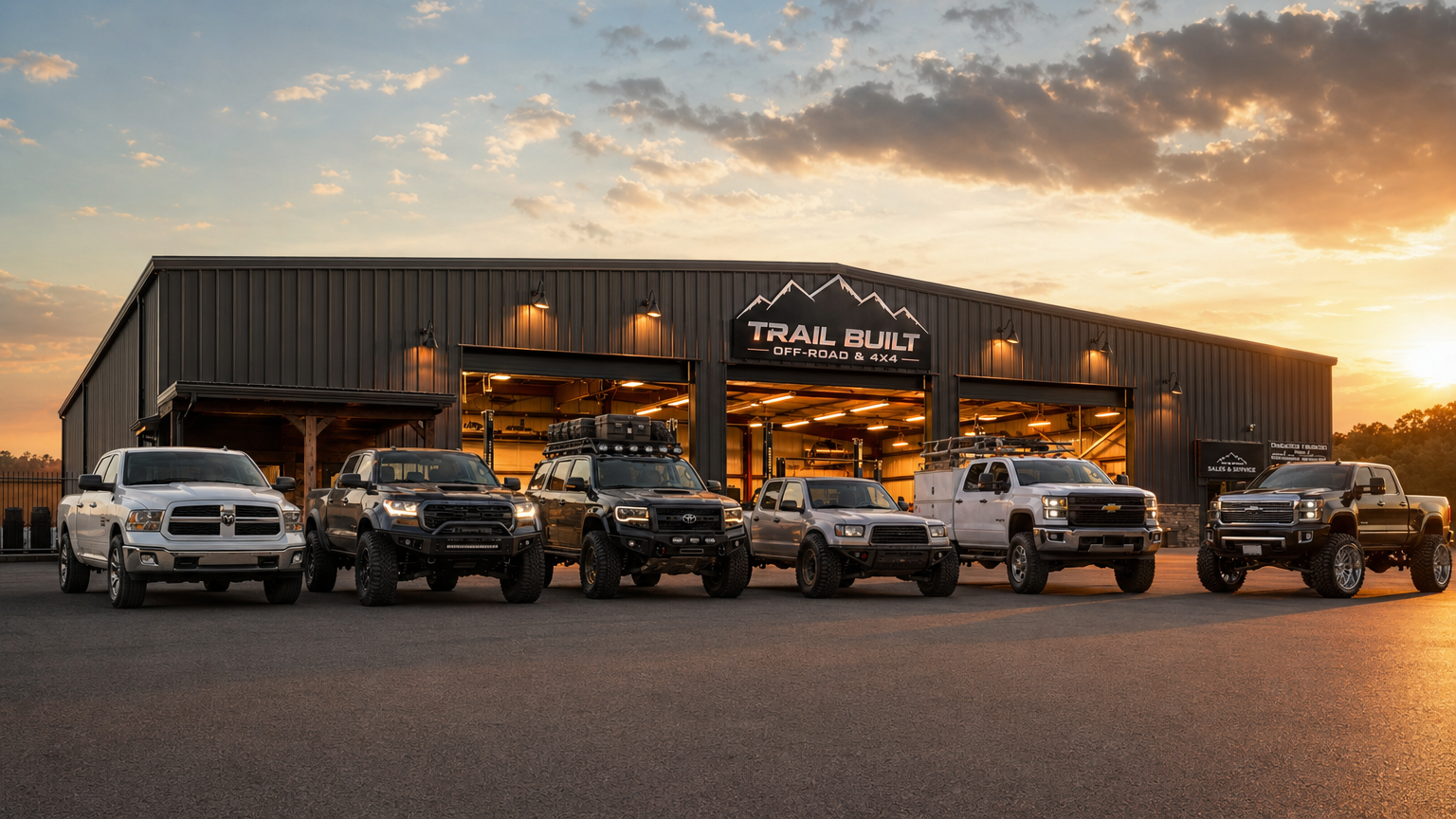
Drives to work Monday through Friday, camps or wheels 2-4 weekends a month. 2" to 3" lift, 33" to 34" tires, a modest armor package, skid plates, a fog/ditch light upgrade, and maybe a dual battery if you run a fridge. Keeps highway manners, passes DPS, and handles 80% of the trails you'll actually see. This is the most common build we do and there's a reason for that.
Dedicated Trail Rig
Not a daily. Trailered or driven to the trailhead, then wheeled hard. 4" to 6" lift, 37" tires, lockers front and rear, full armor, heavy bumpers with winch, and real trail lighting. Gearing, driveshaft angles, and brake upgrades are non-negotiable here because these trucks actually use their capability. Common platforms: JK/JL Wrangler, Tacoma, 4Runner, Bronco.
Overland / Expedition
Self-sufficient travel rigs. Rooftop tent or bed camper, dual battery with 100Ah+ auxiliary, refrigerator, awning, water storage, solar or DC-DC charging, long-range fuel options, and comms (GMRS or ham). Suspension spec balances ride quality under weight with off-pavement capability. Common platforms: Tacoma, 4Runner, Gladiator, Tundra, 200-series Land Cruiser, LX570.
Pre-Runner / Desert
Long-travel suspension, high-speed-off-road focus. Fox or King bypass shocks, reservoir air bumps, chase lights, skid plates that can survive desert whoops, and a real 4-point internal cage if it's going anywhere competitive. These are specialty builds and we spec them carefully because high-speed off-road doesn't forgive budget shocks.
Work Truck Built Right
Primary job is work — job sites, ranch, farm, towing. Needs payload retained, brake capacity retained, and a liner/tonneau combo that keeps tools clean. Lifts are modest (0 to 2.5") to preserve factory ride and tow manners. Adds up to a truck that still does its job and looks intentional instead of aftermarket-clutter.
Show Truck / Expression Build
Built primarily to look right. RGB underglow, full audio, custom wheel fitment, color-matched armor, fender trims, billet accents. Still has to drive and stop and corner — which is why show builds benefit from a full-service shop that treats them as real trucks, not mannequins. We do the cosmetic work without ignoring the mechanical side.
Vehicles & Platforms We Build
We work on every common off-road and truck platform sold in North America, plus a lot of less common ones. Here's a partial list organized by category. If your truck isn't here, call — we've probably worked on it.
Full-Size Trucks
- Ford F-150 (2009-present)
- Ford F-250/F-350 Super Duty
- Ford Raptor (Gen 1, Gen 2, Gen 3)
- Chevy Silverado 1500/2500/3500
- GMC Sierra 1500/2500/3500
- Chevy Silverado ZR2
- Ram 1500 (DS, DT)
- Ram 2500/3500 (incl. Power Wagon)
- Ram 1500 TRX
- Toyota Tundra (1st, 2nd, 3rd gen)
- Nissan Titan / Titan XD
Mid-Size Trucks
- Toyota Tacoma (2nd, 3rd, 4th gen)
- Toyota Tacoma TRD Pro
- Chevy Colorado / ZR2 / Bison
- GMC Canyon / AT4 / AT4X
- Ford Ranger & Ranger Raptor
- Nissan Frontier (D40, D41)
- Jeep Gladiator JT (Sport/Rubicon/Mojave)
- Honda Ridgeline
SUVs & Jeeps
- Jeep Wrangler JK (2007-2018)
- Jeep Wrangler JL (2018-present)
- Jeep Wrangler 4xe
- Ford Bronco (2021-present)
- Ford Bronco Raptor
- Toyota 4Runner (5th gen)
- Toyota Sequoia
- Toyota Land Cruiser (2024+)
- Chevy Tahoe / Suburban
- Ford Expedition
Overland & Expedition
- Toyota Land Cruiser 100-series
- Toyota Land Cruiser 200-series
- Lexus GX460
- Lexus GX470
- Lexus LX470 / LX570
- Mercedes G-Wagen (W463)
- Ram Power Wagon
- Classic FJ40 / FJ60 / FJ62
- Toyota Hilux (import)
Don't see your platform? We also work on vintage 4x4s (Scout II, Bronco I, K5 Blazer, CJ-series Jeeps), medium-duty conversions, and side-by-sides (RZR, Maverick X3, Talon, Can-Am Defender). Call with the year and trim and we'll tell you what we've done on that platform before.
Deep Dive on the Services We're Best Known For
A few of the above services have their own full walkthrough — pricing tiers, build examples, install process, and FAQ. Start here if you already know what you want.
Off-Road Build Terminology, In Plain English
Walk into any shop and you'll hear terms that sound like inside language. Here's what the words actually mean — so you can spec your build intelligently and compare shop quotes fairly.
Axle Regear
Replacing the ring and pinion gears inside your differential with a lower (numerically higher) ratio to recover torque lost when you installed bigger tires. 33" tires on stock 3.21 gears typically want 3.73; 35s want 4.56-4.88; 37s want 4.88-5.13.
Caster Correction
Adjusting control arms or drag links after a lift to restore factory caster angle. Without it, lifted trucks wander, self-center poorly, and chew tires. On JK/JL Wranglers, proper caster is usually 5-6 degrees positive.
Locker vs. Limited-Slip
A locker physically locks both axle shafts together, giving you 100% traction on both wheels (at the cost of turning radius when engaged). A limited-slip sends more torque to the wheel with grip but always allows some slip. Lockers for trail, limited-slips for dailies that see occasional off-pavement.
Selectable Locker
A locker you can turn on and off from the cab (ARB Air Locker, Eaton E-Locker, Yukon Zip). On when you need it, off for street driving. The premium solution and what we install most often for serious builds.
DC-DC Charger
A smart charger (Redarc BCDC, Victron Orion) that takes input from your alternator and/or solar and outputs a proper charging profile to your auxiliary battery. Required for AGM and lithium house batteries — a plain solenoid isolator will ruin them over time.
Battery Isolator
A relay or solenoid (National Luna, Blue Sea ACR) that connects your starting and aux batteries while the engine is running, and isolates them when it's off. Simple and reliable for basic dual-battery setups with lead-acid chemistry.
Skid Plate vs. Underbody Armor
A skid plate typically covers one component (transmission, transfer case, fuel tank). Full underbody armor is a connected system of plates that protects everything from the front cross-member back to the rear differential. Dedicated trail rigs want the full system.
Rock Slider vs. Nerf Bar
Nerf bars are step assists bolted to the body — they'll bend if you rest a rock on one. Rock sliders mount to the frame and are designed to take full vehicle weight on a single point. If you wheel on rock, skip nerf bars.
UHMW vs. Steel Skid Plates
UHMW (ultra-high molecular weight polyethylene) plates slide over obstacles instead of catching. Steel plates are stronger but drag. Serious desert and rock guys run UHMW on high-impact surfaces (tranny pan) and steel where strength matters (diff covers, transfer case).
CB vs. GMRS vs. Ham
CB is legacy trail protocol, no license required, limited range. GMRS is clean FM, short range, license required but simple ($35, no test). Ham radio offers the best range and repeater access but requires a real license exam. Most modern trail groups have moved from CB to GMRS.
SWR Sweep
Standing Wave Ratio — a measurement of how well your radio antenna is tuned to your radio. A bad SWR (over 2.0) means most of your transmit power is bouncing back into the radio instead of going out the antenna. Every radio install here gets an SWR sweep before you leave.
SYE Kit
Slip Yoke Eliminator — replaces the factory slip-yoke output on older NP231 transfer cases with a fixed yoke, allowing a proper CV driveshaft. Mandatory on lifted Jeeps running more than a couple inches of lift or you'll get driveline vibration and premature u-joint failure.
Chromoly Axle Shafts
Upgraded axle shafts made from 4340 chromoly steel instead of factory 1040 or 1541. Roughly twice the strength in torsion. Required on Wranglers and Tacomas that run 35s+ and see real trail use — factory shafts twist and break.
Bump Stop Extension
Taller bump stops to prevent suspension components from crashing into the frame at full compression. Mandatory on lifted trucks running larger tires or you'll fold a shock mount the first time you hit a real bump at speed.
Deadening (Sound Deadening)
A layer of butyl-based mat (Dynamat, Hushmat, Second Skin) applied to door skins, floors, and roof panels to cut resonance and road noise. The single biggest improvement for any audio upgrade, and also makes a stock truck quieter on the highway.
Long-Travel Suspension
Replacing factory control arms with longer units (and matching long-stroke shocks) to increase wheel travel. Used on desert pre-runners and serious trail rigs. Not the same as a lift — lift raises ride height; long travel increases how far the wheel can move.
Backspacing & Offset
Two ways of describing where the mounting face of a wheel sits relative to the centerline. Lower backspacing (more negative offset) pushes the wheel out; higher backspacing pulls it in. Critical for clearing larger brakes, avoiding tire-on-control-arm contact, and not rubbing fenders.
Load Range / Ply Rating
Tire sidewall strength classification. Load Range C is passenger-duty; D is light-truck; E is heavy-duty (10-ply equivalent). Most off-road tires are D or E. E is stiffer and more puncture-resistant but rides harsher. Match load range to use, not trend.
What Sets Iron Ridge Apart
Three things that make the difference between a truck we built and a truck someone else built. These aren't marketing claims — they're operational standards every build leaves under.
Real In-House Fabrication
We cut, bend, weld, and finish steel in the same building where we install. MIG, TIG, and heavy plate welding done by hand, not subcontracted. That's what makes one-off solutions possible — and what makes fixing a prior shop's bad work possible.
If it can be drawn, it can usually be built here, and usually inside a week instead of a month of waiting on a vendor.
2-Year Install Warranty + Manufacturer Warranty Handling
Every install we do carries a 2-year workmanship warranty on labor — welds, fitment, wiring, torque spec, alignment. Every part we sell carries whatever warranty the manufacturer offers (typically lifetime on bumpers, sliders, and armor; 2-5 years on suspension; 1-3 years on electronics).
If a part fails under warranty, we handle the claim. We call the manufacturer, we arrange the replacement, we reinstall it. You don't ship anything back, you don't sit on hold — you just bring the truck.
Every Build Leaves With a Spec Sheet
Before you drive away, you get a printed spec sheet for your records: every part number installed, torque values on critical fasteners (suspension, armor, driveshaft, wheel lugs), gear ratio (if regeared), final alignment numbers, tire pressure recommendations, and SWR readings on any radio install.
A copy stays on file here, so if you come back in three years we already know exactly what's on the truck. It also becomes resale documentation if you ever sell the build.
Full-Service Build Shop FAQ
The questions we get most often from customers who are new to building trucks. If yours isn't here, the consult is free — just call.
Do you install customer-supplied parts?
Yes. We install parts you source yourself at the same labor rate and with the same install warranty as parts we sell — with two caveats. First, we'll tell you honestly if a part you bought isn't right for your build or won't hold up, and the final call on installing it is yours. Second, manufacturer warranty claims on customer-supplied parts are your responsibility to handle with the vendor; we don't broker those.
Can I get multiple services at once, or do I need to stage them?
In almost every case you want them done at once. A lift, tire, alignment, and armor job all touch the same parts of the truck — doing them together saves labor, saves fitment issues, and gets the truck back to you faster. Some work has dependencies (e.g. you need new tires before final alignment), but we sequence all of that on one work order.
How long does a typical build take?
Simple jobs (bed liner, tonneau, single-component install) are often same-day or overnight. A lift with tires and armor on a common platform is typically 2-4 business days. Full ground-up overland conversions run 2-6 weeks depending on fab time, back-ordered parts, and customer decisions along the way. Every quote comes with a written timeline.
Do you offer financing?
Yes. We work with Synchrony, Affirm, and Snap Finance for build financing, with terms from 6 to 60 months depending on the approved amount and your credit profile. For customers who prefer a pay-as-you-go approach, we also accept deposits and staged payments across a longer build.
What's your warranty policy?
Two years on install labor (workmanship, welds, wiring, fitment, torque). Manufacturer warranty on parts, which we handle claims for on your behalf if a failure occurs within the warranty window. Alignment is warrantied for 60 days or 1,500 miles post-install against shop-side error.
Can you work on my newer truck with advanced driver-assistance systems?
Yes. We work on trucks with ADAS (lane keep, adaptive cruise, blind spot, automatic emergency braking) every day. Most modern trucks require calibration if front-end geometry or ride height changes — we either perform the calibration in-house or send the truck to the OEM dealer for calibration as part of the build, with the cost included in the estimate up front.
Do you tune for emissions compliance?
We don't perform tuning that removes or defeats emissions equipment. For gas trucks, we'll install and verify CARB-legal cold-air intakes, high-flow cats, and EO-numbered exhaust systems. For diesels we install DPF-back and DOC-back systems that retain emissions compliance. Texas doesn't currently require OBD-II emissions testing for most counties, but we build as if you might cross state lines.
Do you offer mobile service?
Not for full installs — the shop equipment is what allows the quality of work we deliver. We do offer limited mobile service for specific situations: pre-purchase inspections at a dealer, break-down assistance for customers we've previously built (within the Houston metro), and on-site diagnostic consults for fleet customers.
What happens if a part fails after install?
Bring the truck back. We diagnose, and if the failure is install-side (wiring that vibrated loose, a fastener that backed off, a weld that cracked), we fix it on our dime. If the failure is part-side, we handle the manufacturer warranty claim and reinstall at no labor charge during the warranty window.
Can you match a build to a spec I saw online?
Usually yes, and we'll be honest about any parts of that spec we think are wrong for your use case. If you saw a build photo and want the same stance, armor look, and tire spec, bring the photo to the consult. We'll reverse-engineer the build and quote it accurately.
Do you offer trail support or on-trail recovery?
We don't operate a recovery service, but every build leaves here with a proper recovery kit recommendation (rated shackles, kinetic rope, tree saver, gloves), and we train customers on how to use it safely. For customers building serious expedition rigs, we can introduce you to local off-road clubs that run group trips with experienced recovery operators.
How do I get an accurate quote?
Come by with the truck. We walk it, ask about use case, look at what's already installed (and whether any of it needs to come off), and write the quote while you're here. Phone and email estimates are useful for rough budgeting, but the accurate number always comes from seeing the truck in person. Consults are free.
Serving Drivers From Across Greater Houston
Our shop serves drivers from across the Houston metro and beyond. Wherever you're driving from, we've probably built a truck from your zip code already.