WHERE TO WHEELNEAR HOUSTON
The most complete guide to off-road destinations within driving distance of Houston — organized by distance, difficulty, terrain type, and what your rig actually needs to have a good time rather than a bad day.
A Note About Southeast Texas Terrain
Before you go anywhere, understand what you're dealing with locally.
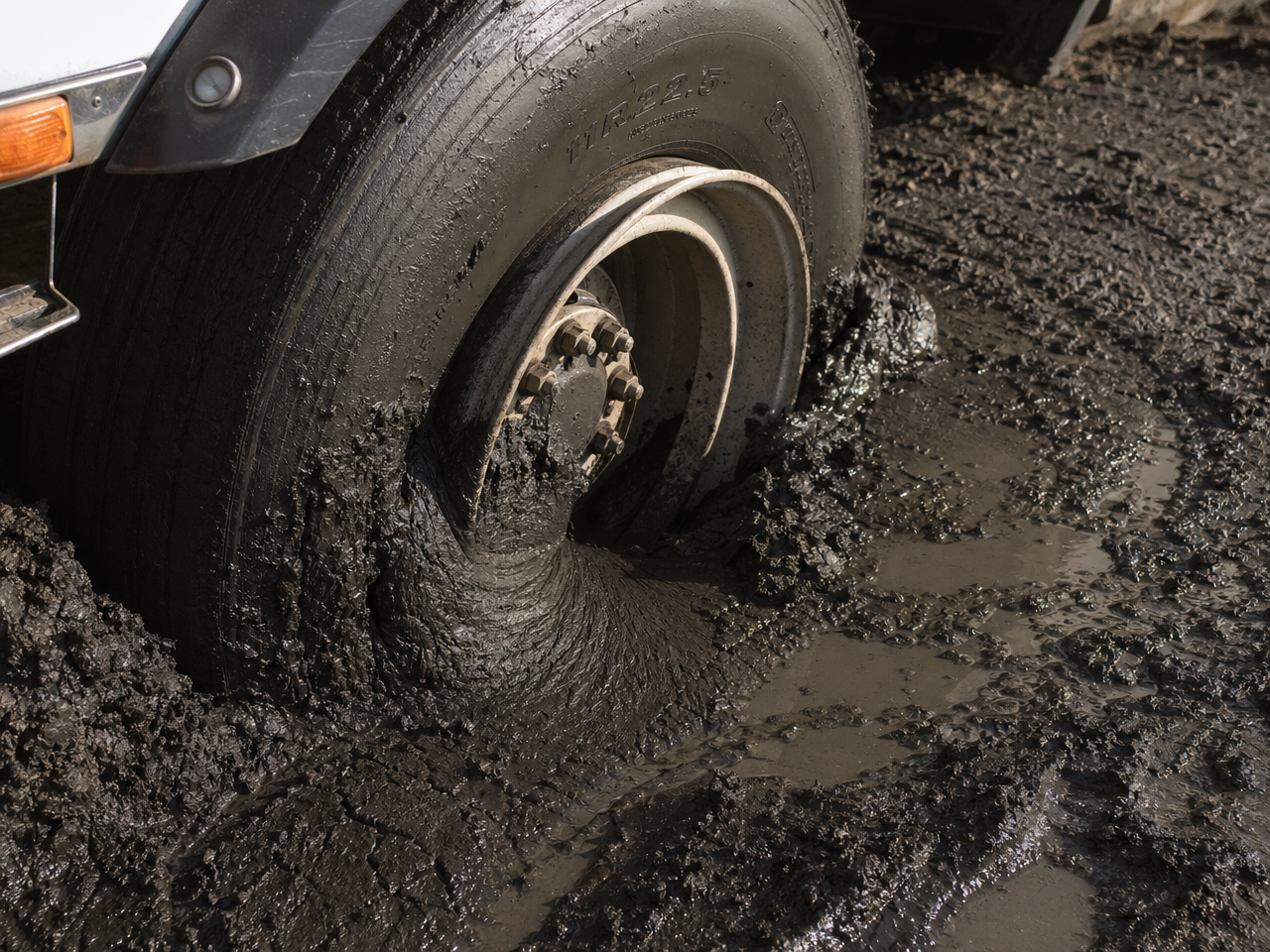
The Houston area sits on Houston Black soil — what locals call black gumbo. This is a Vertisol clay that is unlike any other terrain in the region. When it's wet it doesn't just get slick. It creates a suction effect that can double the apparent weight of your vehicle. It fills tire treads completely, turning even aggressive mud-terrains into slicks. It persists for weeks after rainfall in hidden pits with no firm bottom.
This is not Hill Country caliche. It is not Oklahoma limestone. It is a different animal entirely and it requires specific preparation that we cover in detail below.
Standard recovery gear ratings are calculated for rolling resistance on normal terrain. Black gumbo suction load can multiply extraction force requirements by 2 to 3 times. A winch rated at 1x your vehicle weight is undersized for serious Houston terrain. Kinetic recovery ropes only — static straps snap under suction load.
Seasonal Guide
Feb — April ✓
Best months. Mild temps, manageable ground conditions, before summer heat sets in.
Nov — Jan ✓
Excellent wheeling. Cool temps, dry spells common. Watch for cold fronts and surprise rain.
May — Oct ⚠
Manageable with planning. Rain risk high May–June and Sept–Oct. Summer heat is real.
June — Aug ✕
Brutal. Baked clay ruts destroy suspension. Heat is dangerous. Horseflies are not a joke.
Within 2 Hours of Houston
The closest wheeling to Houston — from your first trail run to your first serious mud experience.
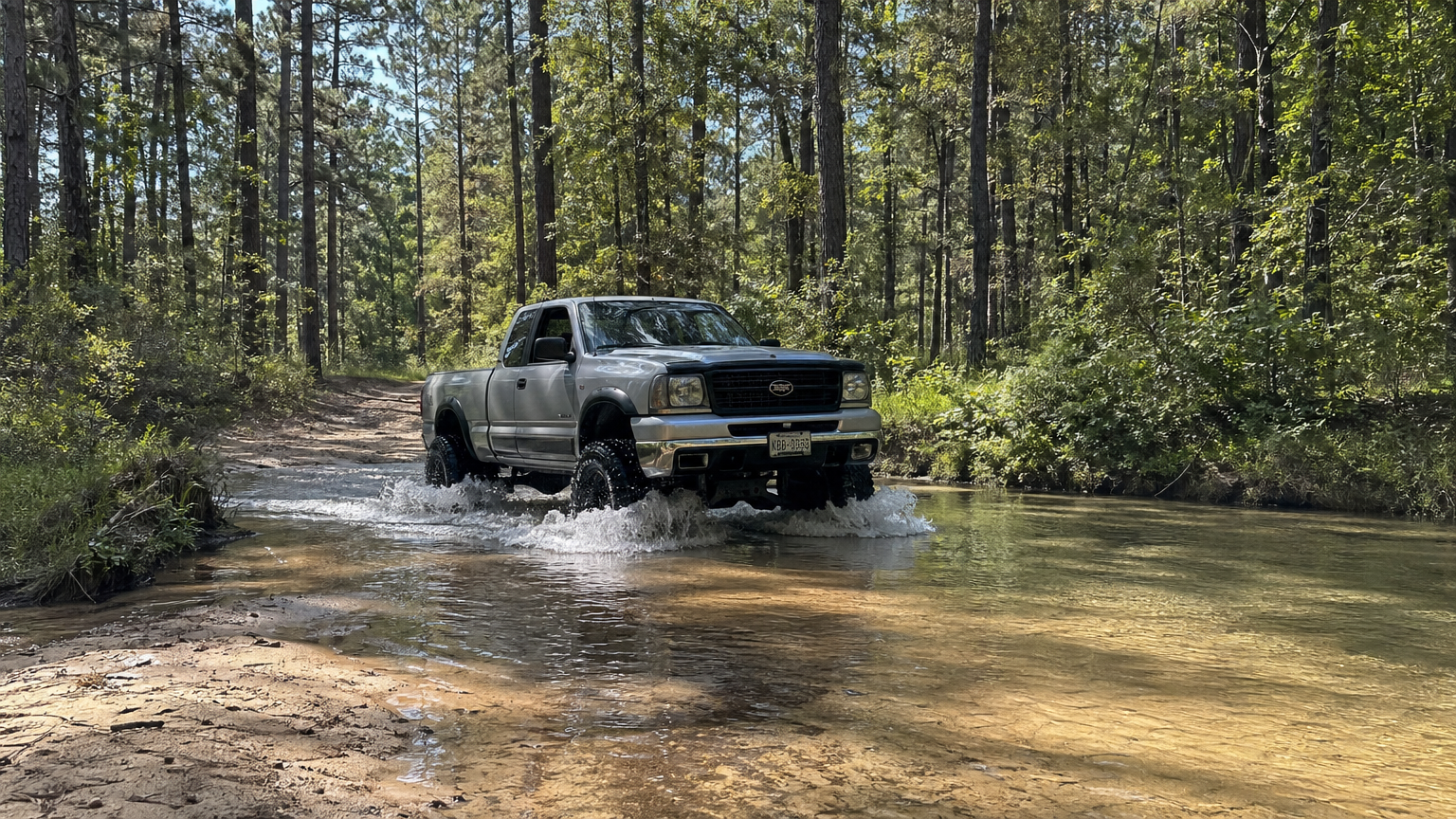
400 acres of sandy woods, deep mud pits, and natural creek crossings through Peach Creek. This is the most accessible entry point for Houston-area wheelers — beginner to moderate difficulty, family-friendly, and close enough for a half-day trip. Stock to lightly modified 4x4s can have a legitimate good time here.
If you've never wheeled before, start here. If you've been wheeling for a decade, the mud pits still earn their reputation after a rain event.
Stock 4x4 handles the easy sections comfortably. Mud-terrain tires are strongly recommended for anything beyond the basic trails. The mud pits are real mud pits — don't come in all-terrain tires and expect to come out clean. Kinetic recovery rope and a friend with a working winch are the right call before you go anywhere near the pits.
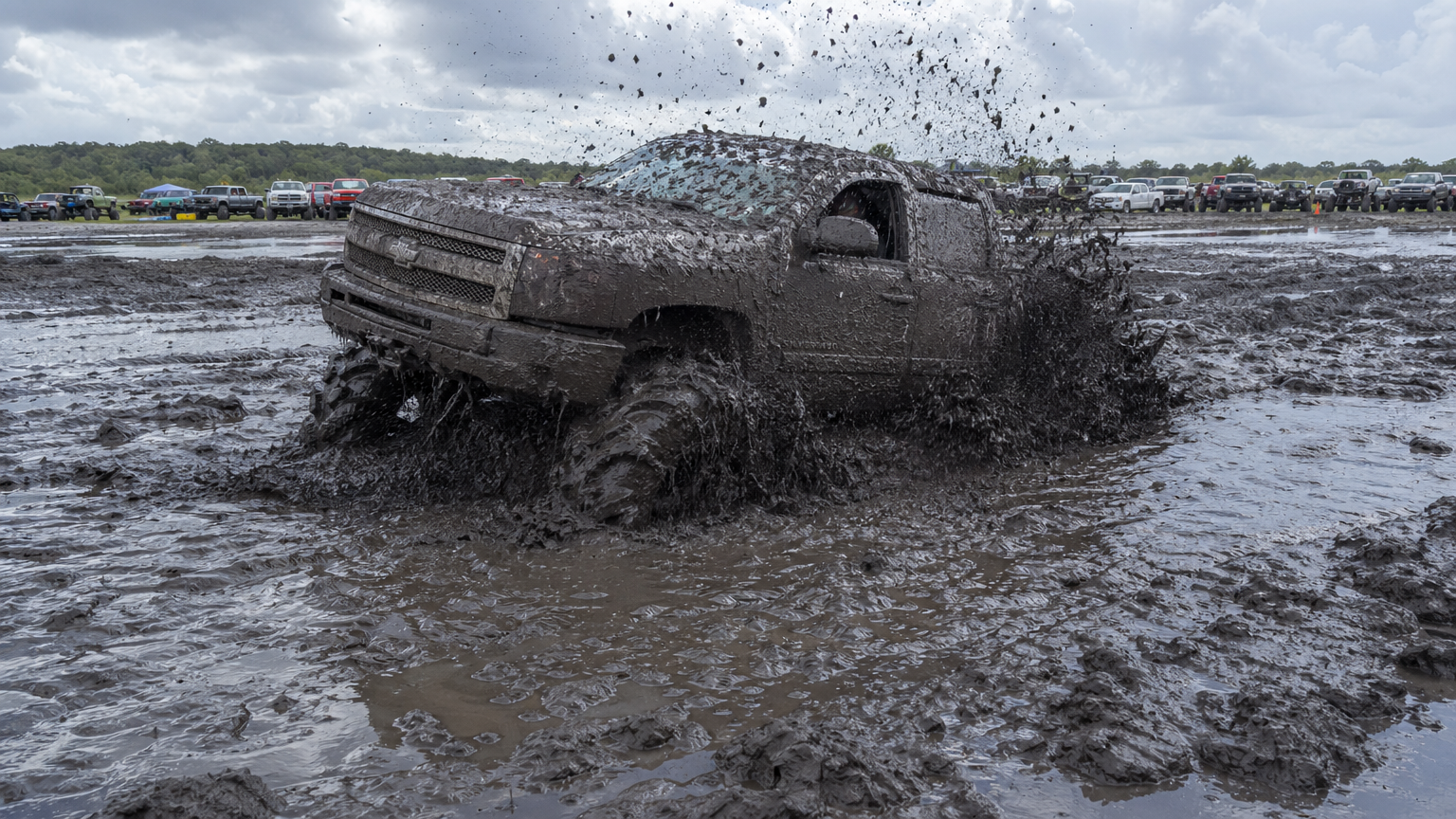
1,600 acres in the San Jacinto River valley. Houston's biggest and most well-known off-road facility and it earns the reputation. The engineered bounty holes are built for mega trucks and serious mud rigs. The deep mud bogs are genuinely extreme — vehicle submersion is a real possibility in the most technical sections.
There's also a beach area, boat ramp, and a summer event series that draws serious crowds. This is not a beginner park. Come prepared or come to watch.
Aggressive mud-terrain tires minimum. Winch rated at 1.5 to 2 times your vehicle weight — the black gumbo suction effect is no joke and standard winch ratings don't account for it. Extended breather tubes for your differentials, transmission, and transfer case if you're going deep. Kinetic recovery rope only — a static strap in Houston gumbo can snap under suction load.
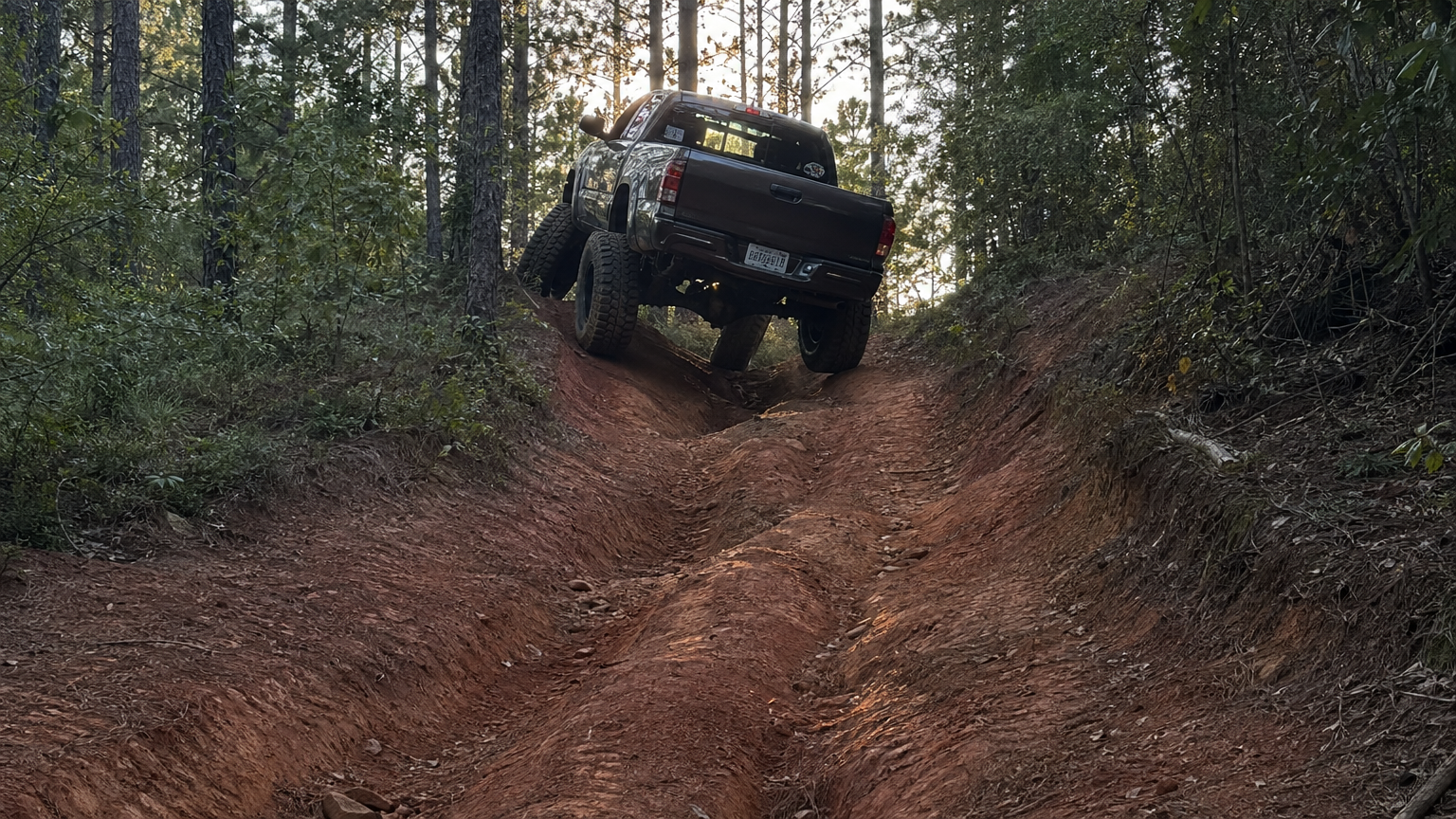
706 acres, over 60 miles of trails through rolling piney woods. Spring-fed creeks, sandpits, deep mud holes, and imported limestone and concrete obstacles for rock crawling simulation. This is where you go when you want more than mud but aren't ready for a destination park.
The technical trails are legitimately challenging — steep, rutted hill climbs that demand modified rigs. Note: motorcycles and dirt bikes are prohibited. Tires larger than 44 inches are not permitted.
Stock 4x4s can run the perimeter access roads without issue. Technical trails require minimum 33-inch tires and at least one locking differential — you will get stuck without it on the steep rutted sections. Mud-terrain tires on anything beyond the easy routes. The limestone obstacles are forgiving on armor but the hill climbs are not.
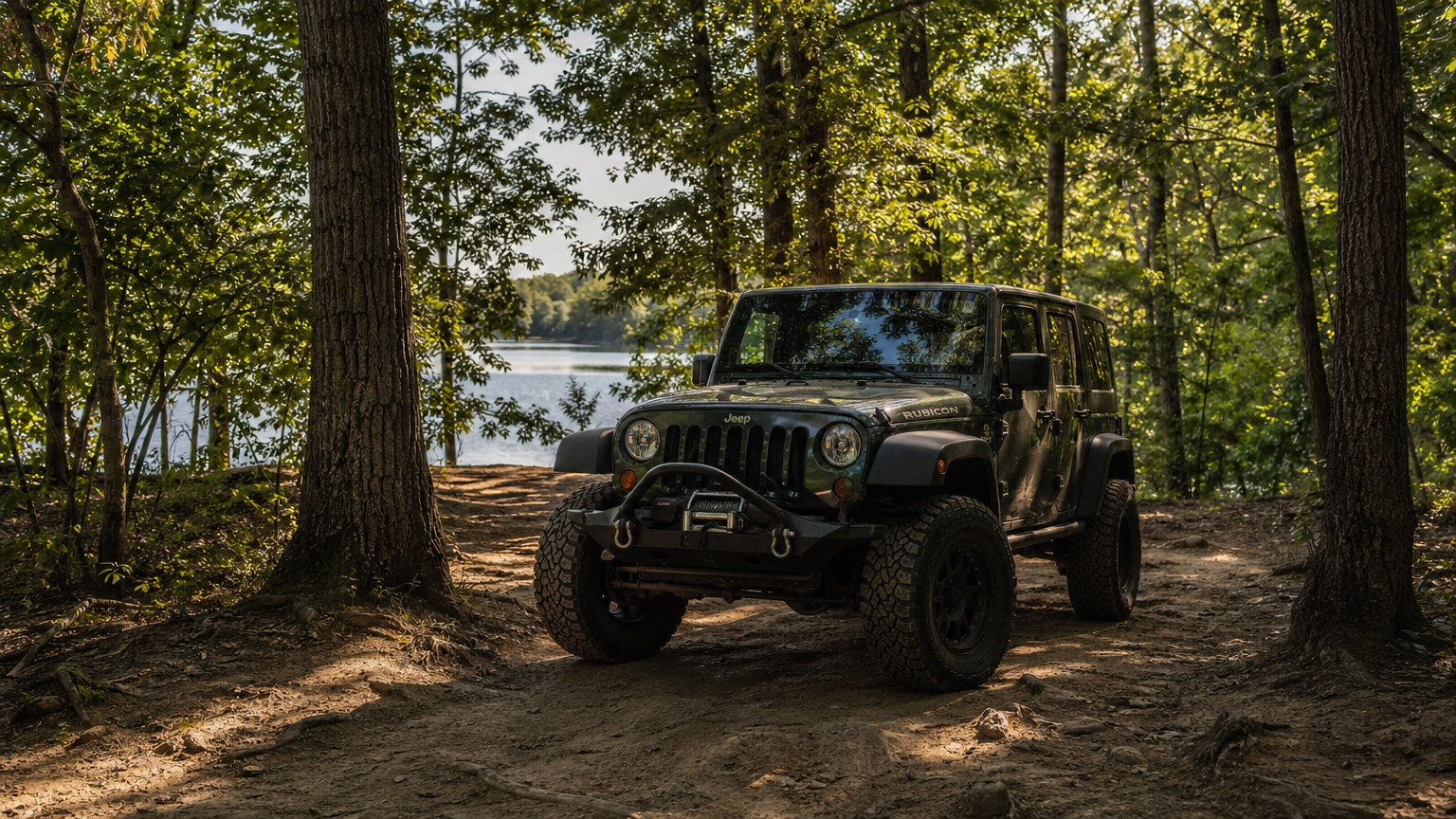
700 acres of wooded trails, hill climbs, multiple lakes, deep mud bogs, and a beach area. Mostly amateur to novice level with pockets of expert terrain in the mud pits. Motorcycles and dirt bikes prohibited. A solid middle-ground between Creekside and Xtreme for riders progressing through skill levels — enough challenge to learn without being overwhelmed.
Stock 4x4 handles the easier sections. Mud-terrain tires and recovery gear before you try the bogs. Same black gumbo rules apply — kinetic rope over static strap, winch rated to account for suction, don't wheel alone.
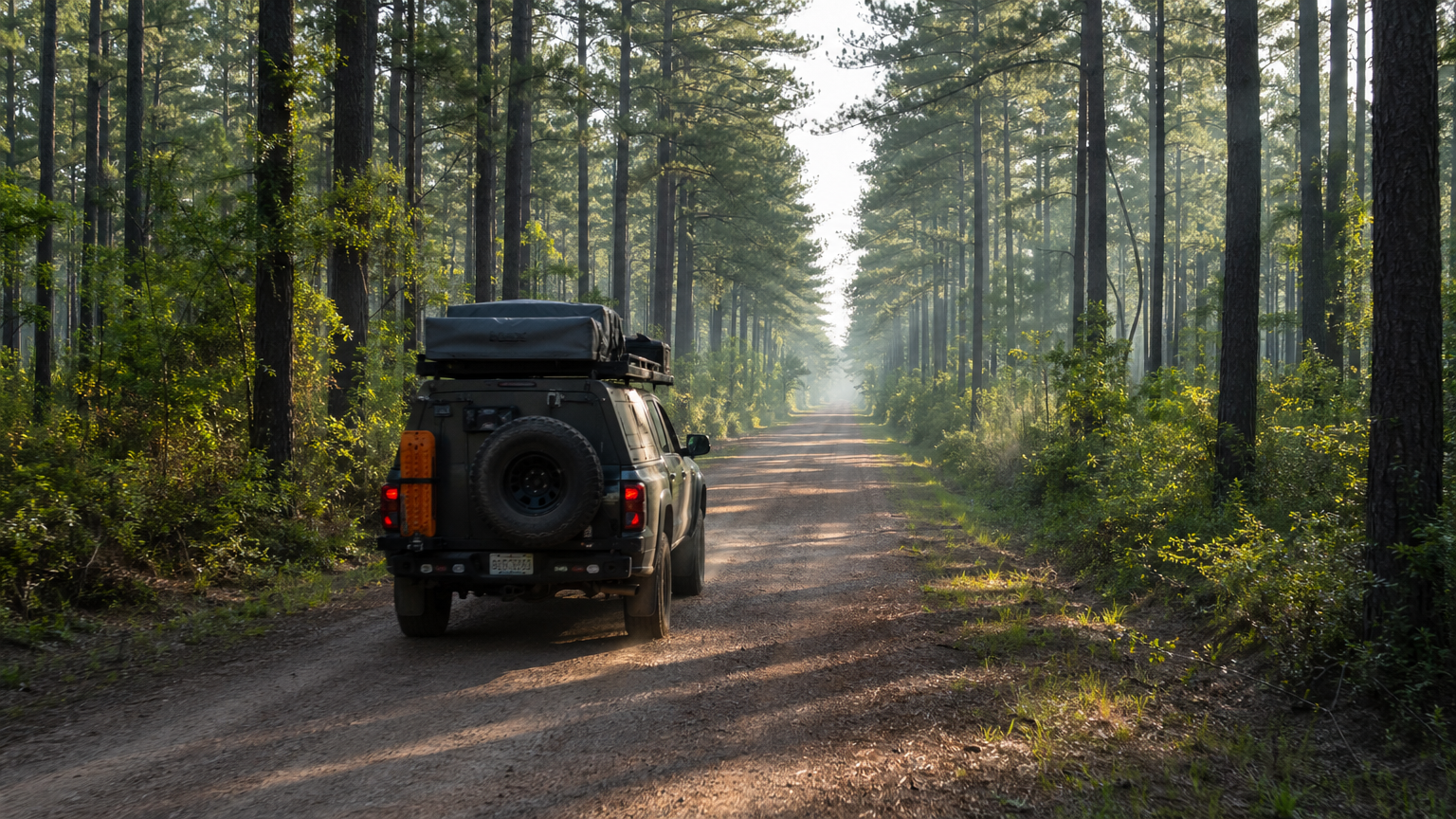
The top destination for full-size street-legal 4x4s who want an overland experience rather than a mud pit. The Texas Traverse route runs through here — an expansive network of Forest Service Roads through the Piney Woods. Easy to moderate under dry conditions, escalating quickly after rain when low-lying sections turn to deep muddy ruts.
Full-size 4x4s are welcome on the Forest Service Roads here. The 85-mile OHV trail system in Sam Houston National Forest is NOT — those trails are restricted to vehicles 50 inches wide or narrower. Know the difference before you plan your route. A full-size truck on a narrow OHV trail is both illegal and a recovery problem.
Street-legal 4x4 in good mechanical condition. Mud-terrain tires not required but strongly recommended for wet conditions. Onboard air for airing down on softer sections. Recovery gear as always — even easy routes get complicated after rainfall in the Piney Woods. Download offline maps — cell service is inconsistent.
2 to 4 Hours from Houston
Step up in technical difficulty when you're ready for terrain that demands a properly built rig.
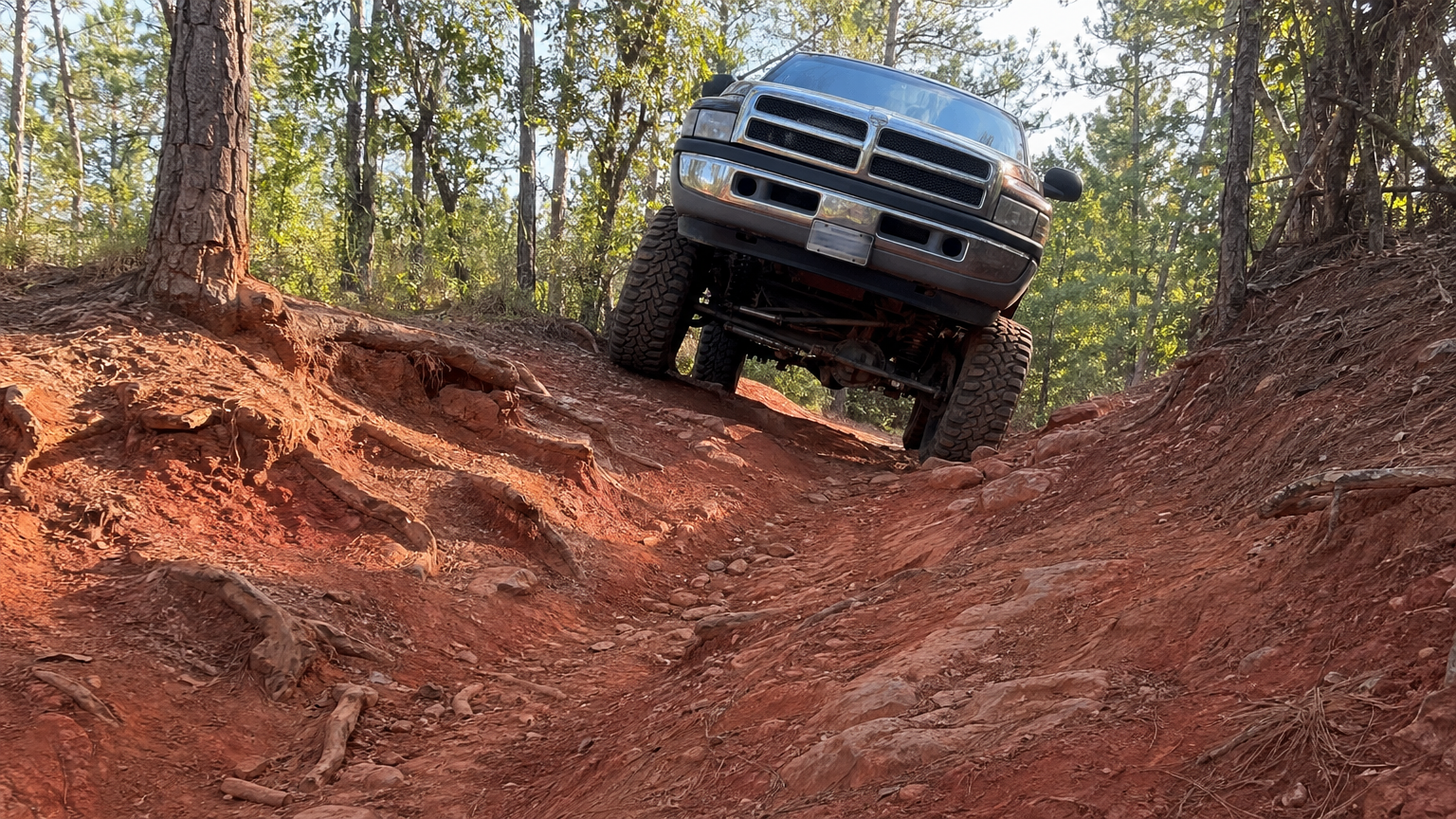
1,000 acres and 36 miles of trails through red dirt, deep mud pits, rock gardens, and off-camber hill climbs. Easy to moderately difficult. A good step up from the local parks when you're ready for more technical terrain without committing to a full destination trip. The red dirt here behaves very differently from Houston's black gumbo — more traction when dry, more manageable when wet, but the hill climbs are steeper than anything near the city.
33-inch or larger tires recommended. The hill climbs demand proper 4-low technique and enough ground clearance to not high-center on the rutted sections. Recovery gear standard. The rock gardens are low-consequence — good for practicing line selection without heavy armor stakes.
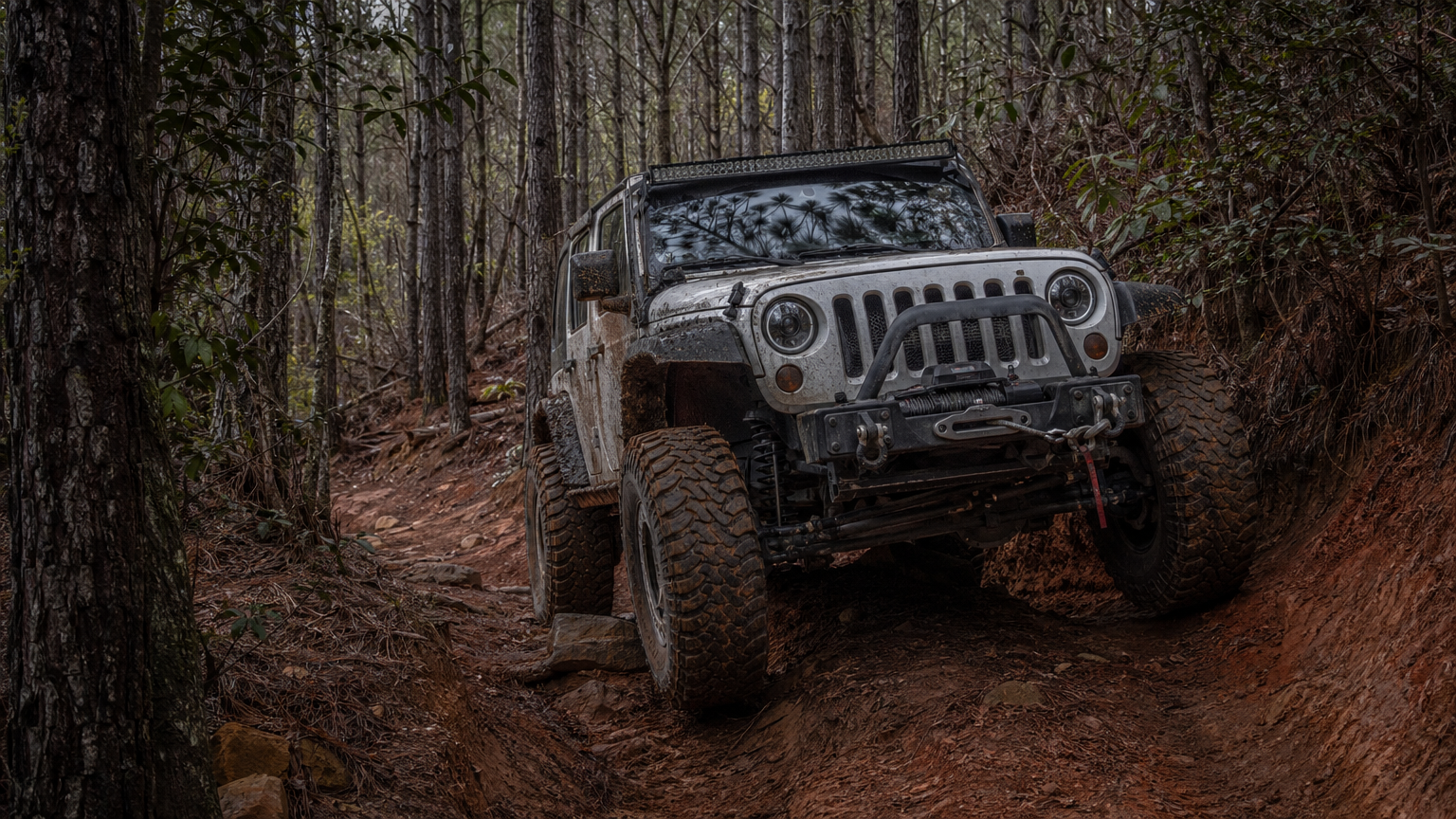
1,850 acres of clay and pine topography owned by the Texas Motorized Trails Coalition. This is where East Texas off-roading gets serious. Technical wooded trails, high-degree off-camber rock climbs, and iron-rich clay that turns frictionless the moment it gets wet. Obstacles like Rock Garden and Jeep Eater earned their names honestly.
If you've never gotten the East Texas Pinstripe — the brush scratch marks from navigating tight wooded trails — Barnwell will give you your first. The terrain demands a built rig, not just a lifted one.
Aggressive mud-terrain tires — mandatory, not suggested. All-terrain tires will clog immediately in the clay. Long-arm suspension and disconnected sway bars for maximum articulation in the rock gardens. Rock sliders and full belly skid system for the boulder obstacles. Winch. This is not a beginner destination.
4 to 6 Hours from Houston
Purpose-built terrain that demands purpose-built rigs. Plan your build before you plan your trip.
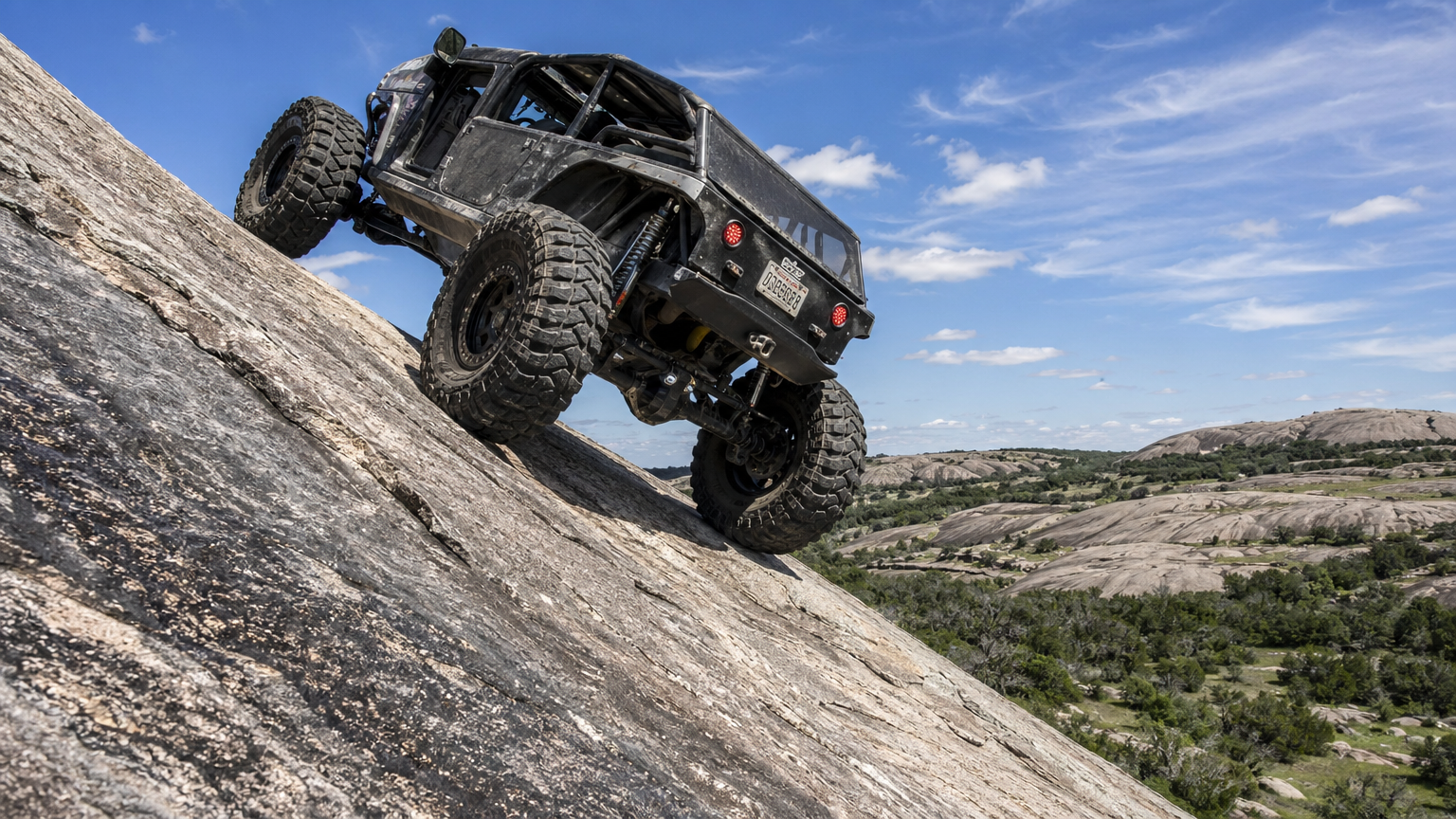
800 acres of Precambrian granite domes in the Hill Country. Widely regarded as the premier rock crawling destination in South-Central United States. The granite provides near-unlimited traction — which sounds like an advantage until you realize it means all the force goes directly into your drivetrain. U-joints snap. Axle shafts shear. Level 4 trails require a properly anchored roll cage.
ATVs, UTVs, and motorcycles are prohibited entirely. This is not a park you visit to see if your rig can handle it. You build your rig for this park and then you visit.
37-inch or larger tires on quality beadlocks. Chromoly front axle shafts — stock shafts do not survive Level 3 and above regularly. Lockers front and rear. Full armor and rock sliders that are weld-on frame-mounted, not bolt-on body-mounted. A proper roll cage if you're running Level 4. Know your rig's limitations before you arrive — the granite does not forgive overconfidence.
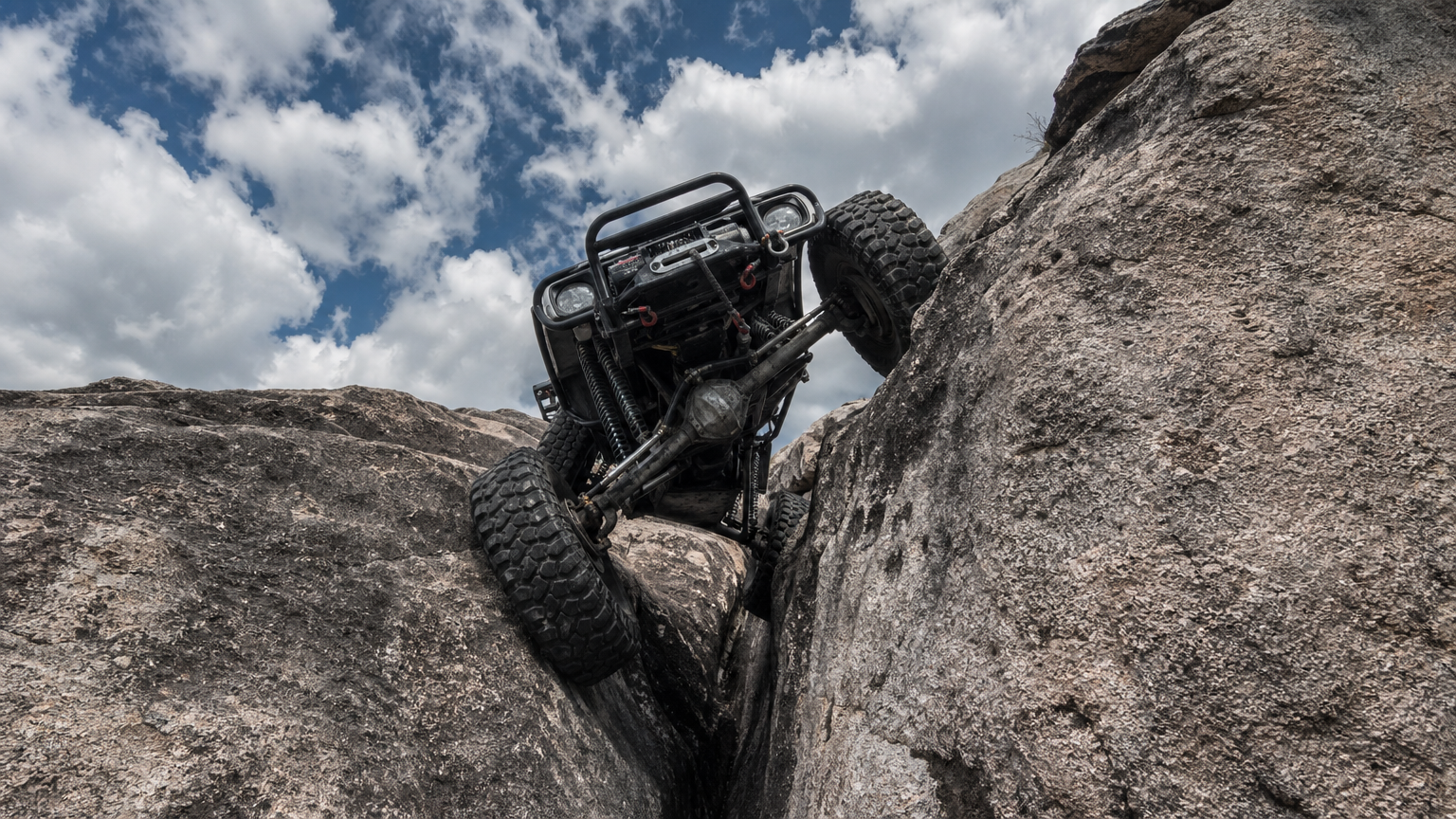
Famous for its color-coded trail system where the Purple trails — ratings 8 through 10 — represent the absolute ceiling of off-road difficulty in Texas. The 30-foot vertical climb on Big Bad Wolf and the dual-crack navigation of Carnivore are the kinds of obstacles that separate purpose-built rigs from everything else. One-ton axles. Rear steering. Full armor.
The Yellow trails (rating 4) have a suggested minimum of a 4-inch lift and 35-inch tires. There's room here for a well-built Phase 1 or 2 rig — plan your trail selection against your build honestly before you arrive.
Yellow trails: 4-inch lift minimum, 35-inch tires, lockers recommended. Orange trails: 37s, lockers required, full skids. Red trails: 40s, lockers front and rear, full armor, experienced spotter. Purple trails: Everything on Red plus one-ton axles or equivalent. Know which color you're running before you pull in.
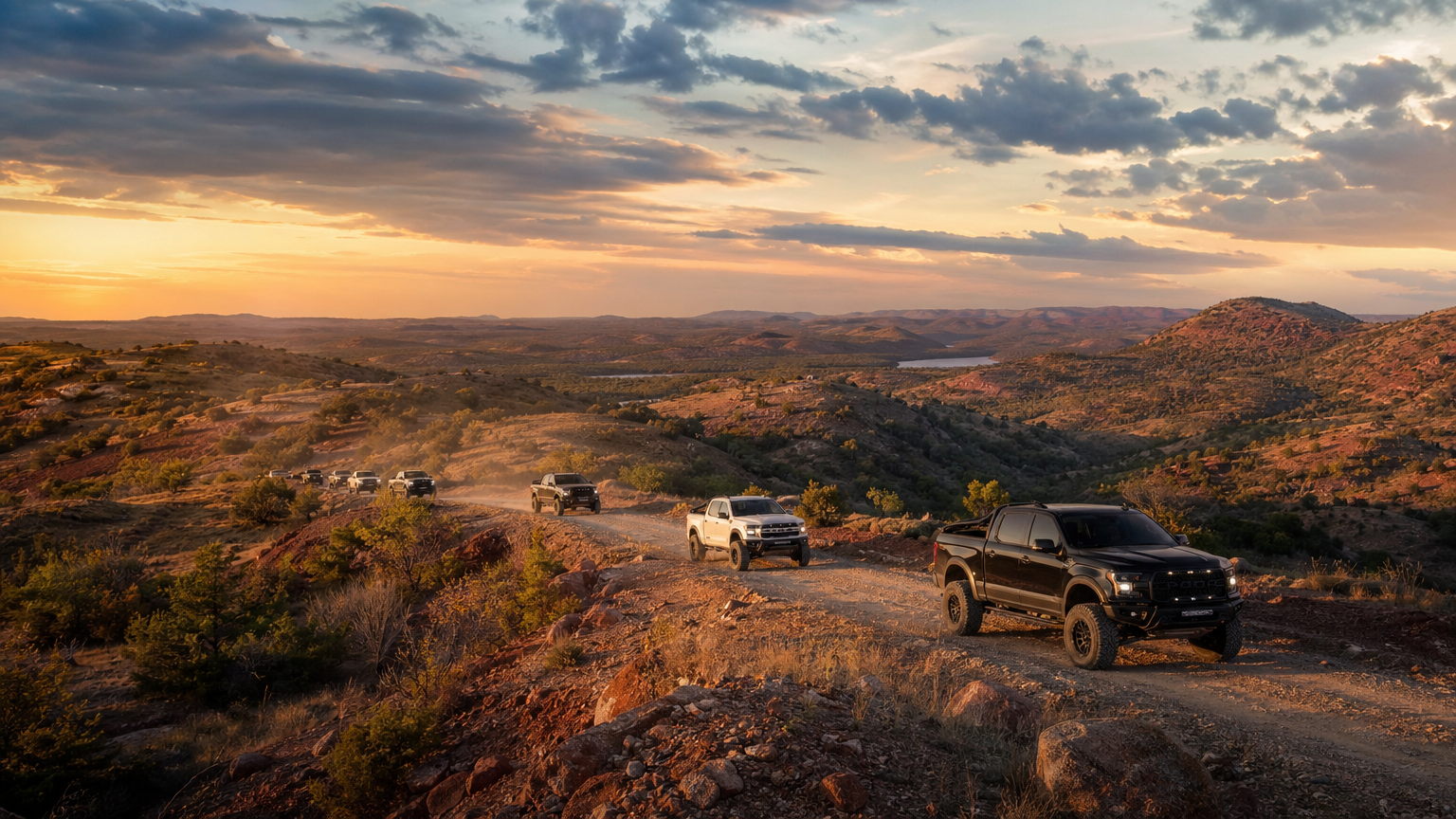
The largest off-road park in Oklahoma and Texas. 6,500 acres and over 200 miles of trails in the Arbuckle Mountains. The North Face trail offers an official Jeep Badge of Honor. Weather changes the difficulty rating dramatically — a moderate trail on a dry day becomes an extreme trail after rain.
24-hour riding is allowed, making it the only major destination where you can legitimately test your auxiliary lighting in true blackout conditions. This is the destination where lighting builds get proven.
Varies widely by trail selection. Beginner loops require stock 4x4. The technical sections require the same level of prep as Barnwell — mud-terrain tires, lockers, recovery gear. If you're going specifically to test lighting builds, come with a full kit, onboard air, and a recovery partner who knows what they're doing in the dark.
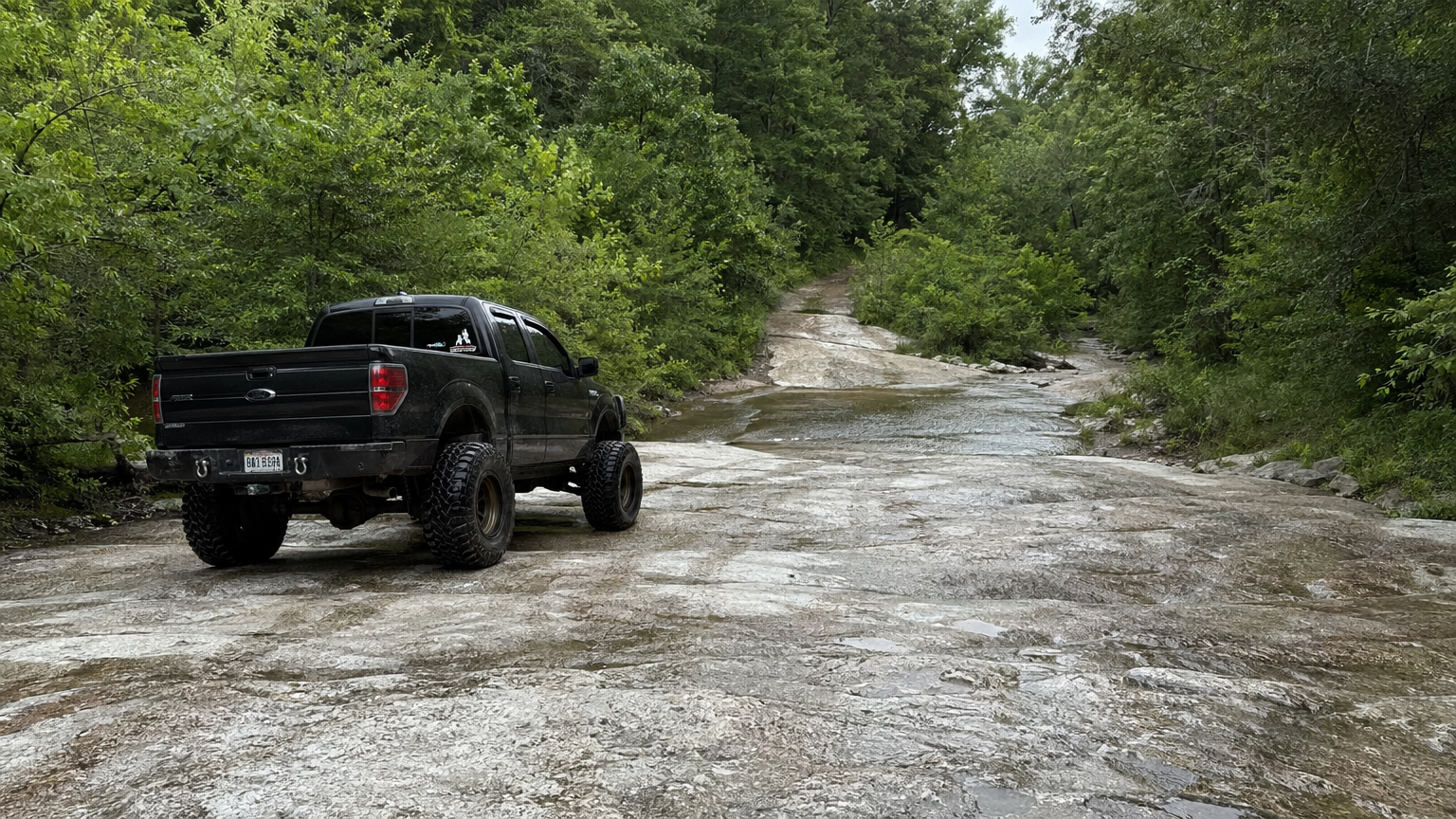
A surprising rock crawling experience in a state most wheelers dismiss as flat mud country. Slick limestone, steep hills, deep water crossings, and iron-rich clay that makes surfaces frictionless when wet. Appointment only — call ahead before you make the drive. Mud-terrain tires are not optional here — all-terrain tires will leave you stuck before you've gotten anywhere interesting.
Aggressive mud-terrain tires. Lockers recommended for the limestone sections. Breather tube extensions for differentials before any serious water work — the crossings here are real crossings. Recovery gear full kit. Call ahead for current conditions — Louisiana weather and water levels change fast.
Build Requirements by Destination
Every destination in this guide mapped to minimum build requirements. The right question isn't "can my truck handle it" — it's "what does this terrain actually demand?"
| Destination | Min. Lift | Tire Size | Tread | Locker | Armor | Winch |
|---|---|---|---|---|---|---|
| Creekside Ranch | Stock OK | Factory | MT Recommended | Not Required | Not Required | Recommended |
| Dirty South 2.0 | Stock OK | Factory | MT Recommended | Not Required | Not Required | Recommended |
| Xtreme Off-Road | 2"+ Lift | 33"+ MT | MT Required | Recommended | Sliders Recommended | Required |
| General Sam's | 2"+ Lift | 33"+ MT | MT Recommended | 1 Locker Required | Skids Recommended | Recommended |
| Davy Crockett | Stock OK | Factory | MT Recommended | Not Required | Not Required | Recommended |
| Shiloh Ridge | 2"+ Lift | 33"+ MT | MT Recommended | Recommended | Skids Recommended | Recommended |
| Barnwell Mountain | 4"+ Lift | 35"+ MT | MT Required | Both Axles | Full Skids + Sliders | Required |
| Cross Bar Ranch | Varies by Trail | 35"+ for Tech | MT for Tech | Tech Trails | Tech Trails | Recommended |
| Catahoula Recreation | 3.5"+ Lift | 35"+ MT | MT Required | Recommended | Skids Recommended | Required |
| Katemcy Rocks (K2) | 4"+ Lift | 37"+ Beadlock | MT Required | Both Axles | Full Armor Required | Required |
| Wolf Caves — Yellow | 4"+ Lift | 35"+ MT | MT Required | Recommended | Skids Recommended | Required |
| Wolf Caves — Purple | 6"+ Long Travel | 40"+ Beadlock | MT Required | Both + 1-Ton Axles | Full Armor Required | Required |
Bring your truck in for a free build assessment. We'll tell you exactly what terrain you're ready for right now, what it would take to get to the next level, and whether the investment makes sense for how you actually wheel. No pressure, no hard sell.
Before You Go — Every Time
Regardless of where you're headed, these basics apply on every trip. The ones people skip are the ones that end trips early.
Know Your Terrain
- Research terrain type before you arrive — clay, granite, limestone, and sand all demand different technique and different tires
- Check current conditions — call the park, check Facebook groups, look for recent posts
- Know where the bypasses are on every rated obstacle before your tires are on the rock
- Download offline maps — cell service does not exist where the good trails are
Air Management
- Air down before the trail — 15 to 20 PSI for dirt trails, lower for rock crawling
- Air back up before the road — trail pressure on the highway is dangerous and destroys tires
- Carry onboard air or a quality compressor — not a CO2 tank that runs out three tires in
- Know your minimum safe bead-seating pressure for your tire and wheel combination
Water Crossing Protocol
- Walk every water crossing before you drive it — Houston-area waterways are opaque and deceptive
- If the water is above your knees on foot, it is too deep for most stock 4x4s
- Current applies 500 pounds of lateral force per foot of depth — this number moves trucks
- Breather tube extensions on differentials, trans, and transfer case before any serious water work
Group Safety
- Never wheel alone on technical terrain — minimum two vehicles
- GMRS radio minimum for group wheeling — cell service is not reliable where the good trails are
- Designate one spotter per obstacle — never move without clear spotter communication
- Know the nearest hospital from every trailhead before you need it
Recovery Essentials for Houston Terrain
The black gumbo suction effect changes your recovery gear requirements compared to other regions. Standard recovery gear ratings are calculated for rolling resistance on normal terrain. Houston gumbo is not normal terrain.
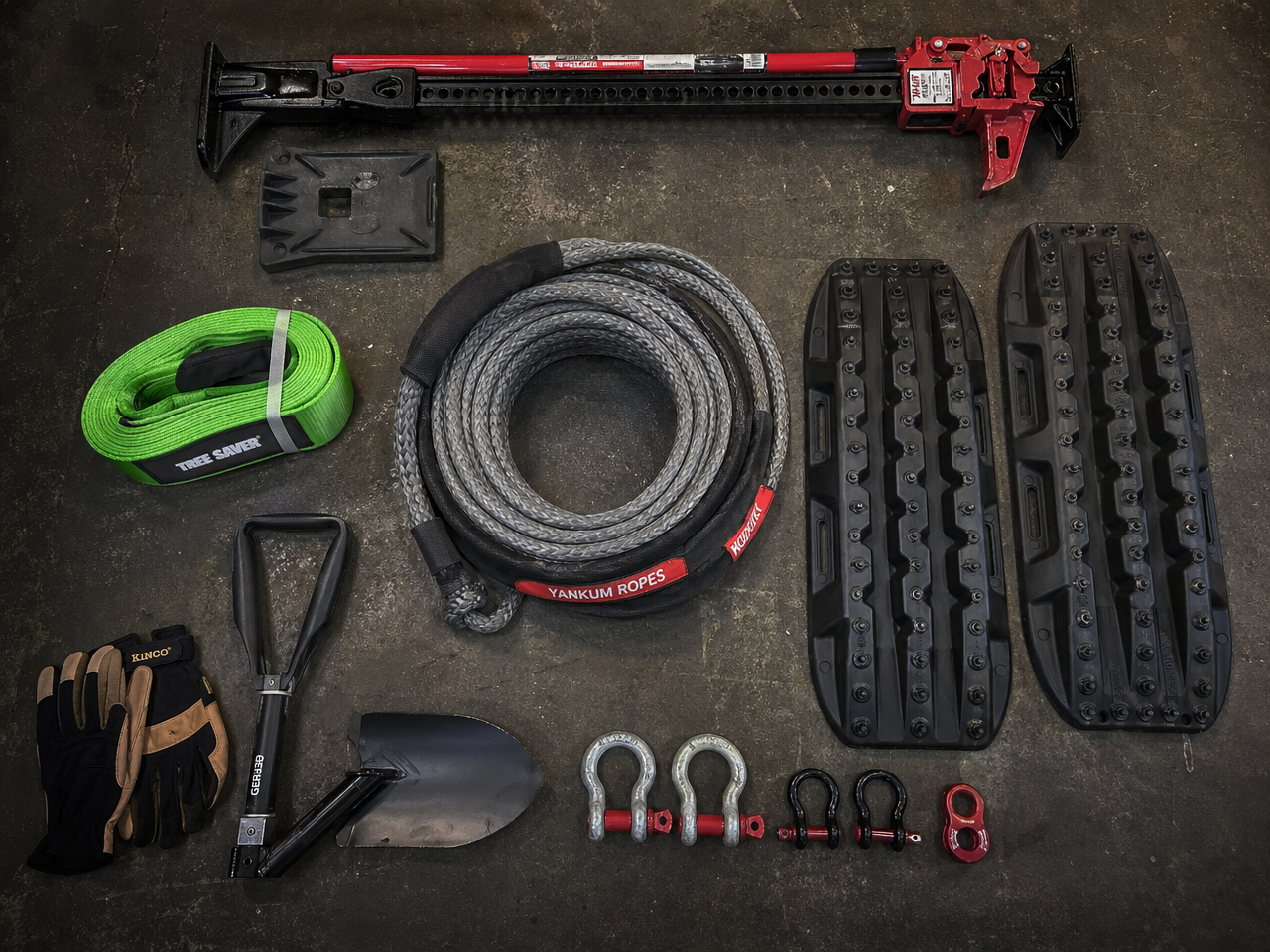
Kinetic Recovery Rope
Rated for your vehicle weight minimum. Not a static tow strap — static straps in Houston gumbo snap under suction load. The kinetic stretch is what allows extraction without shock-loading your recovery points or your buddy's bumper.
Winch — Properly Rated
Rated at 1.5 to 2 times your gross vehicle weight. Standard ratings are calculated for rolling resistance, not suction extraction. The force required to break a vehicle free from black gumbo suction can exceed 2x the vehicle weight before the rig moves an inch.
Hi-Lift with Base Plate
The jack will sink before it lifts on soft ground without a base plate. A piece of 3/4-inch plywood works in a pinch. A purpose-built hi-lift base plate is better. Always carry the handle keeper — a hi-lift under load with a loose handle is a liability.
Recovery Boards
Essential in sand and black gumbo for traction under spinning tires. Place them under the drive wheels, not under the tire that's already sunk — you need traction from the tire that's still gripping. MaxTrax or ARB Tred Pro quality, not hardware store plastic.
Breather Tube Extensions
For differentials, transmission, and transfer case before any serious water work. The alkaline silt in Houston waterways corrodes standard weatherproof connectors quickly. Apply dielectric grease to all electrical contacts before any water crossing that's more than a puddle.
Dielectric Grease
On all electrical contacts if you're going anywhere near Houston-area waterways. The alkaline silt corrodes standard weatherproof connectors faster than you'd expect. Apply before the trip, not after you notice the issue — corrosion in a connector is invisible until it fails at the worst moment.
We'll Tell You Straight
If you're looking at these destinations and not sure whether your build is ready for the terrain you want to wheel, come talk to us. We'll tell you honestly what you have, what you need, and what it costs to close the gap — or whether where you're going is already within reach.
Request a Build Consultation
Tell us where you want to wheel and what you're running — we'll tell you where you stand.
Greater Houston & Surrounding Areas
Iron Ridge Off-Road is at 6420 Westheimer Rd, Houston TX. We've built rigs for wheelers from every corner of the metro — and we know the roads to every destination on this page.