Body Lift Kit Install.
A body lift does one thing extremely well: it creates tire clearance. By raising the body off the frame with polyurethane spacer blocks, it opens the gap between your tires and the fender openings without touching the suspension geometry, ground clearance, or any of the reasons a suspension lift costs more. It's the right tool when your suspension height is already where you want it and your tires are rubbing the body. That's a specific problem with a specific solution — and this is it. After a body lift, a quick alignment check confirms the steering geometry is unaffected.
Body Lift vs. Suspension Lift: What Each One Actually Does
The most common confusion we see is owners using "body lift" and "suspension lift" interchangeably, assuming they accomplish the same thing at different price points. They don't. They solve different problems.
A suspension lift raises the entire vehicle. The frame goes up. The axles go up. Ground clearance increases. The suspension geometry changes — which is why it requires an alignment and, at higher lift heights, geometry correction components. A suspension lift makes your truck more capable off-road because the whole vehicle is higher off the ground.
A body lift raises only the body. The frame stays exactly where it is. The axles stay exactly where they are. The ground clearance is unchanged. What changes is the distance between the body and the top of the tires — which means a tire that was rubbing the fender flare or wheel well may now clear. That's the use case for a body lift, and it's a legitimate one. It just doesn't accomplish what a suspension lift accomplishes.
Where the two work together: a 3" suspension lift combined with a 2" body lift gives a truck's body the equivalent height of a 5" suspension lift at lower total cost. The suspension lift handles the ground clearance. The body lift handles the tire-to-fender clearance for running an oversize tire that would rub on the body at the suspension height alone. It's a rational combination when both problems exist. For a lighter touch, a leveling kit can be all the lift some trucks need.
If you want more ground clearance, more trail capability, and better approach/departure angles — you want a suspension lift. If you have enough suspension height and you want to fit a taller tire without rubbing the fender — a body lift is the right call. We help you figure out which situation you're in at the consult.
What a Body Lift Does — and What It Doesn't
What a Body Lift Accomplishes
- Creates clearance between tires and body — solves fender rub on oversized tires
- Allows fitting a larger tire at existing suspension height without body contact
- More economical than a suspension lift when ground clearance is not the goal
- Does not require an alignment — suspension geometry is unchanged
- Pairs with a suspension lift to maximize tire clearance at lower total cost than suspension-only
- Retains factory suspension ride quality — no geometry changes, no spring rate changes
What a Body Lift Does Not Do
- Does not increase ground clearance — the frame, axles, and differentials stay at the same height
- Does not improve approach or departure angles — those are determined by frame and suspension height
- Does not improve off-road capability directly — ground clearance is what matters on trail
- At 3", requires body gap covers and extended accessories (steering shaft, radiator brackets) on some platforms
- Not appropriate as a standalone solution for owners who want a "lifted" look for trail use — suspension lift is correct
Tire Clearance Without Suspension Change: What the Install Involves
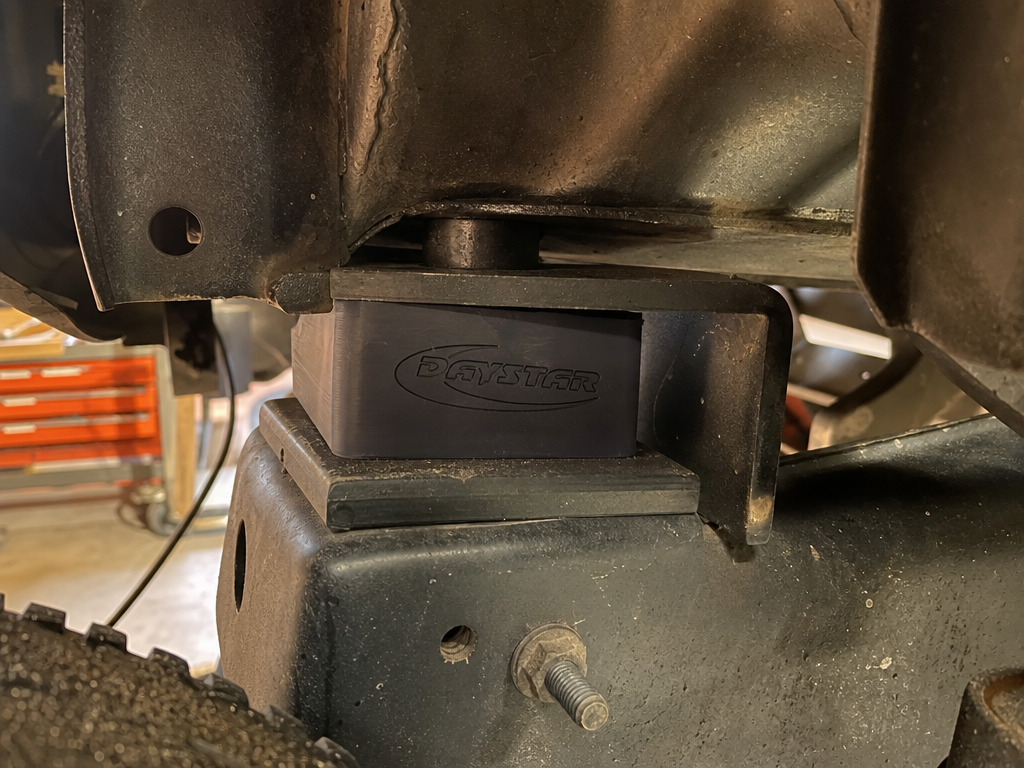
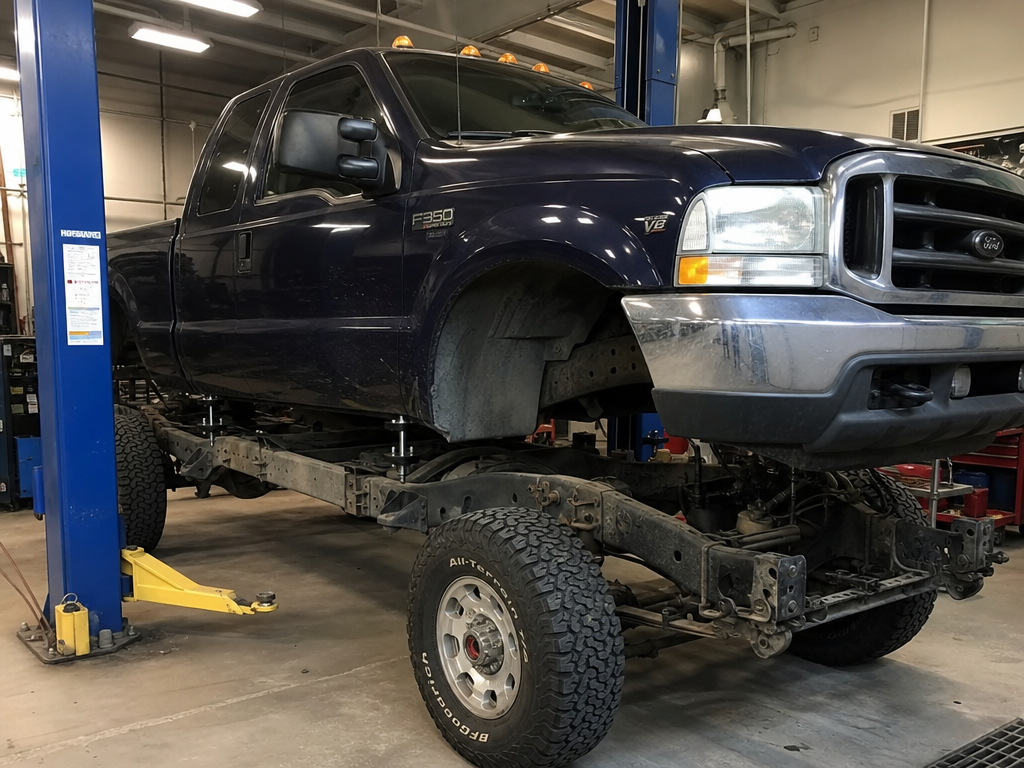
A body lift install involves removing the bolts that secure the body to the frame, inserting polyurethane or steel spacer blocks at each body mount, and re-securing with longer bolts that account for the additional stack height. It's a more involved process than it sounds — a full-size truck has eight to twelve body mount locations, all of which need to be addressed evenly, and several accessories that connect the body to the frame (steering shaft, wiring harnesses, transmission shifter on some trucks) need to be extended or adjusted.
At 1"–2" of lift, a body lift is typically a straightforward day job. At 3", it extends to a full day and may require gap covers on the body-to-fender transition and extended transmission linkage on older trucks. We review the platform-specific requirements at the consult — the component list varies by vehicle.
What doesn't change: the suspension, the alignment, the ride height from the ground, and the factory steering geometry. After a body lift, your truck handles identically to how it did before the install. The only difference is the tires no longer contact the body. Once installed, wheels and tires can be finalized for the new clearance.
Spacer Blocks
Quality body lift kits use high-density polyurethane or steel spacers — not rubber pucks that compress over time and allow the body to settle. We specify per-platform kits from reputable manufacturers. Cheap spacers from no-name kits crack, compress, and shift, which allows the body to creak and move.
Extended Bolts
Every body mount gets a longer grade-8 bolt that spans the new spacer stack. Reusing factory-length bolts on a body lift creates an undertightened connection — the bolt threads don't fully engage. This is not optional. Every body mount gets the correct bolt for the new stack height.
Gap Covers & Extensions
At 2"–3", the visible gap between the body and the frame requires cosmetic gap covers on most platforms. Steering shaft extensions, bumper brackets, and transmission linkage extensions may be needed depending on the platform and lift height. We assess this at the consult and include required accessories in the build quote.
Common Questions About Body Lift Kits in Houston
Body Lift Installs Serving Greater Houston
Iron Ridge Off-Road is on Westheimer Rd in Houston. We install body lift kits for truck and SUV owners from Katy, Sugar Land, The Woodlands, and across the Houston metro.