Short Arm Suspension.
Short arm suspension is the right answer for most Jeep and truck builds in the 2"–4" lift range. It uses the factory mounting points, installs faster than a long arm system, costs less, and — spec'd correctly with geometry correction and alignment — performs extremely well on Texas trails and Houston highways alike. The question isn't short arm vs. long arm. The question is whether your lift goal and use case warrant the added cost and complexity of going long. Most don't.
Short Arm vs. Long Arm Jeep Suspension: The Honest Answer
The short arm vs. long arm debate gets oversimplified online. Long arm systems aren't inherently superior — they're appropriate for a specific use case: lifts above 4 inches where consistent suspension geometry through the full travel range is the priority. That's a real use case. It's just not the use case for most of the builds we do.
A quality short arm kit — from Rough Country, Synergy, Metalcloak, or BDS — at 2"–4" of lift, installed with proper geometry correction components (track bar drop bracket, caster correction cam bolts or UCAs where the platform requires them), and followed by a proper four-wheel alignment, will drive well on the highway and perform well on trail terrain up to serious rock crawling. The Jeep's articulation at 3.5" on a short arm system is more than enough for the vast majority of what Texas off-road terrain demands.
Not ready to go full short arm yet? A leveling kit is a solid Stage 1 option that gets you 2"–2.5" of nose lift and larger tire clearance before committing to a full suspension system. Where short arm runs into its limit: above 4 inches, the factory-length control arms begin to create geometry inconsistencies through the suspension travel range — particularly pinion angle change and axle wrap under torque. That's where long arm suspension makes sense. Below that ceiling, short arm is the smarter spend.
A $2,500 short arm kit installed correctly — with geometry correction and a proper alignment — will outperform a $4,000 long arm kit installed without those steps. Installation quality matters more than arm length in the typical build range.
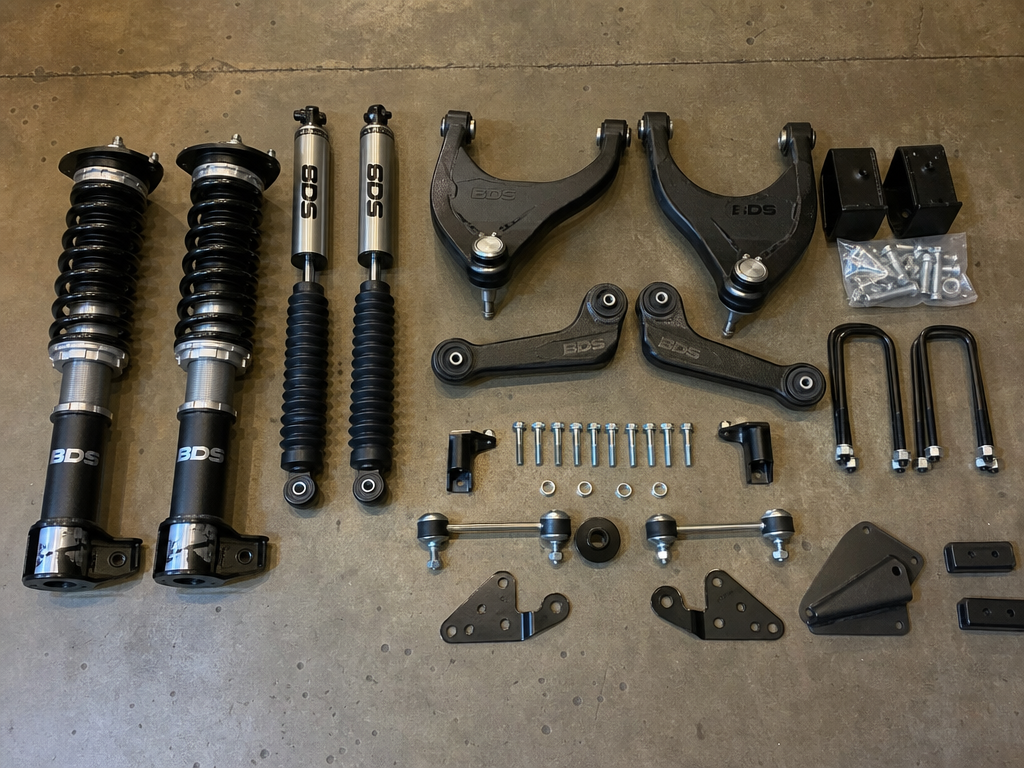
What a Short Arm Lift Kit Install in Houston Includes
A short arm suspension install is not just swapping control arms. Done correctly, it's a full geometry correction — arms, track bar, caster, and alignment. Here's what the complete install covers.
Control Arms
Aftermarket upper and lower control arms replace the factory units. Quality short arm kits use heavy-wall DOM tubing with rebuildable, greaseable joints that outlast the factory rubber bushings significantly. The arms are the same approximate length as factory — the improvement is in materials, joint quality, and adjustability.
Coils or Coilovers
The lift height comes from the spring upgrade — taller, stiffer coil springs or adjustable coilovers that allow the suspension to sit at the target lift height while maintaining proper travel. Spring rate selection matches the vehicle's weight and intended use. A trail rig and a daily driver need different spring rates even at the same lift height.
Track Bar Correction
On solid-axle vehicles, the track bar must be corrected when lifting. A drop bracket or adjustable track bar restores the correct angle and prevents the axle lateral movement that causes death wobble after a lift. This component is not optional on any short arm kit we install at 2.5" and above.
Caster Correction
Lifting without correcting caster changes how the axle tracks under load. Caster correction via cam bolts, correction plates, or adjustable upper control arms is required on most platforms at 2.5"+ of lift. Correct caster setting is verified after installation during alignment — not assumed from the parts spec sheet.
Shocks
New shocks are part of every short arm install. Factory shocks are calibrated for factory ride height and will bottom out or overextend on a lifted suspension. We specify shocks matched to the new ride height and spring rate — Bilstein, Fox, or King depending on the build level and budget.
Post-Lift Alignment
Every short arm install at Iron Ridge includes a full post-lift alignment. Caster, camber, and toe are set to spec for the new ride height. A short arm kit on a truck that hasn't been aligned is a truck waiting to develop handling problems — we don't let trucks leave without it.
Short Arm vs. Long Arm Suspension: Geometry, Cost, and Lift Range
Short Arm — When It Wins
- 2"–4" lift range — where most builds live
- Uses factory frame and axle mounting points — no cutting, no welding required
- Faster installation — typically 1–2 days vs. 2–4 days for long arm
- Significantly lower cost for equivalent lift height
- Proven performance on trail terrain up to serious rock crawling at 3.5"–4"
- Easier future service — standard joint sizes, wider parts availability
Short Arm — Where Long Arm Takes Over
- Above 4" of lift — geometry inconsistencies through the travel range become meaningful
- High-flex competition trail use — long arm's extended arc improves articulation at the extremes
- Severe axle wrap under high torque — longer arms reduce wrap significantly
- Builds where suspension travel is maximized — long arm provides more usable travel at 5"+
- Frame modification is acceptable — if you're already cutting the frame for a bumper, long arm adds limited additional complexity
Short Arm Lift Range
2" to 4" is the effective range where short arm geometry performs at its best. At 2.5" and above, geometry correction is required. At 3.5"–4", a high-quality short arm kit with UCAs and track bar is a complete, capable suspension system — not a compromise.
Platforms We Build
Jeep Wrangler JK and JL. Jeep Cherokee XJ. Ford Bronco. Toyota Tacoma, 4Runner, and Tundra. Ford F-150 and F-250. Ram 1500 and 2500. Chevy Silverado and Colorado. If you run it in Houston and it has a suspension, we've likely built it.
What We Don't Do
We don't install short arm kits without geometry correction at lift heights that require it. We don't skip alignment. We don't recommend a system that's too short for your lift goal or too aggressive for your intended use. The consult exists to make sure the spec is right before anything is ordered.
Common Questions About Short Arm Jeep Suspension in Houston
Short Arm Suspension Installs Serving Greater Houston
Iron Ridge Off-Road is on Westheimer Rd in Houston. We install short arm suspension systems for owners from Katy, Sugar Land, The Woodlands, and across the metro. Most short arm builds complete in one to two days.