Toyota Tacoma 3 Inch Lift Kit.
Three inches is the most popular Tacoma lift because it's the number that gets you into 33-inch tires, meaningful ground clearance, and genuine trail capability — without turning your daily driver into a project. Done correctly, a 3-inch lift with upper control arms also improves on the Tacoma's factory geometry. Done incorrectly, it accelerates wear and makes the truck wander on the highway. The difference is in the components and the installation.
What a True 3-Inch Tacoma Lift Kit Install Requires
The 3rd gen Toyota Tacoma uses independent front suspension with front struts and rear leaf springs. Lifting 3 inches on the front means replacing the factory strut assembly with an adjustable coilover — or, at minimum, a quality spacer — and correcting the geometry that changes when you raise the suspension. On the rear, a leaf spring upgrade or add-a-leaf pack matches the front lift and restores the truck's level stance. If you are deciding between a full lift and a simpler option, see our comparison of leveling kits for the Tacoma.
The component that most builders miss is the upper control arm. At 2.5 inches and above, the 3rd gen Tacoma's factory UCA geometry creates a caster deficit that makes the truck track poorly at highway speed and accelerates ball joint wear. This isn't a hypothetical — it's a documented behavior pattern we see in Tacomas that were lifted elsewhere without UCAs. Aftermarket UCAs from Total Chaos, Icon, or SPC correct the caster angle and restore proper ball joint alignment through the full suspension travel range.
A Tacoma 3-inch lift kit done right is not a cheap project. But it's also one of the most rewarding — the combination of a quality coilover, matching UCAs, and a proper rear spring upgrade transforms how the truck rides both on- and off-road. We spec every Tacoma build after a consult, not from a parts picker.
Many shops and online installers offer "3-inch Tacoma lifts" with spacers and no UCA. At that lift height without UCA correction, you'll have negative caster, accelerated ball joint wear, and a truck that pulls under braking. It's not a shortcut — it's an incomplete installation. We don't build Tacomas that way.
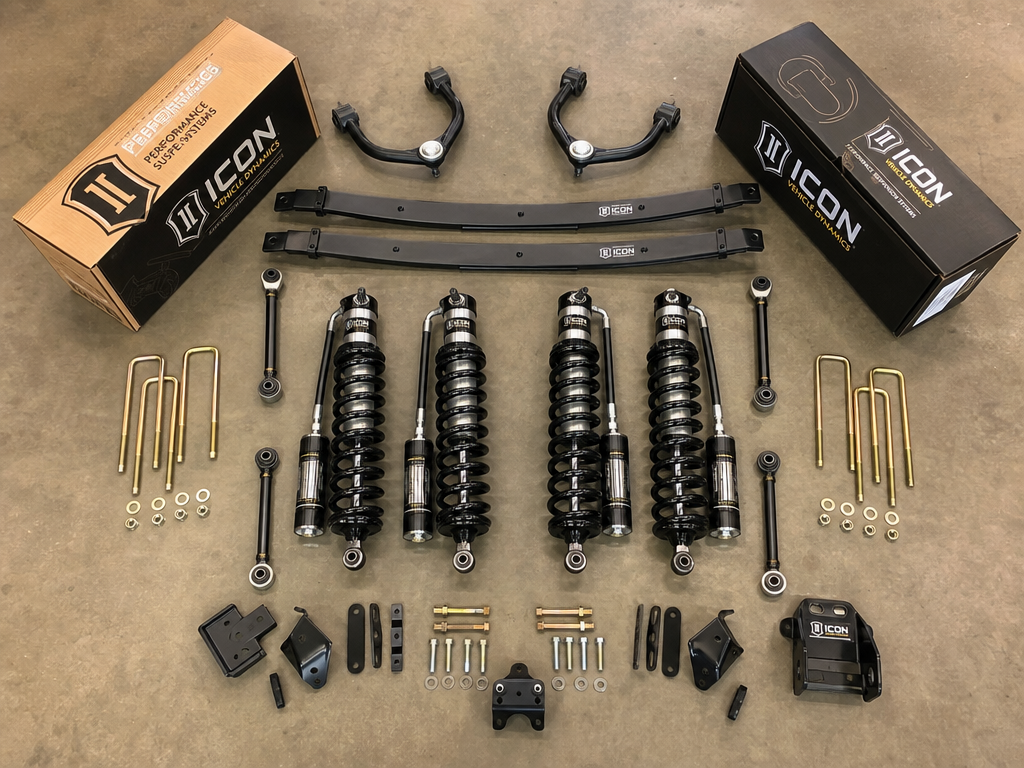
Every Component in a Complete 3-Inch Tacoma Lift Install
A complete Tacoma 3-inch lift is four components — front strut assembly, upper control arms, rear spring upgrade, and post-lift alignment. Here's what each one does and why it matters.
Front Coilover or Strut
Replaces the factory front strut. The Bilstein 6112 is the benchmark for most Tacoma builds — it's height-adjustable from 1.75" to 2.5" of lift, built for long service life, and compatible with OEM geometry. Fox 2.0 and Icon coilovers step up in damping adjustability for more trail-focused builds. Spacers are a budget option — fine for a mild bump, not our recommendation at 3 inches.
Upper Control Arms
The most important geometry correction at this lift height. Aftermarket UCAs — Total Chaos, Icon, SPC — extend the arm length and correct the caster deficit created by lifting the front without changing arm geometry. They also fit higher-quality ball joints with better wear ratings than the factory unit. Any shop quoting a 3-inch Tacoma lift without UCAs is quoting you an incomplete build.
Rear Suspension Upgrade
The 3rd gen Tacoma rides on rear leaf springs. Matching a 3-inch front lift requires either an add-a-leaf (AAL) pack for moderate load and lift, or a full progressive-rate leaf replacement for better performance and capacity. Access Cab models can run a coil spring rear setup on certain builds. Rear blocks alone are not our recommendation — they add lift without improving spring rate or travel.
Post-Lift Alignment
The Tacoma's IFS geometry changes significantly at 3 inches of lift. A full four-wheel alignment is required after every lift installation — it's not optional and it's not included in most online or big-box installs. Every Iron Ridge build includes alignment. Post-lift alignment on a truck with UCAs requires an alignment tech who understands caster correction settings, not just a toe-in adjustment.
Rear Shock Upgrade
A rear shock upgrade matches the improved damping of the front coilover system and prevents the rear from feeling wallowy over trail terrain. Bilstein 5160 remote reservoir shocks are the standard recommendation for Tacoma trail builds. Fox 2.0 IFP rear shocks cover the same need at a slightly lower price point.
Tires & Wheels
At 3 inches with correct offset wheels, a 285/70R17 (33" equivalent) clears on virtually every 3rd gen Tacoma. Moving to a 285/75R17 at 3" typically requires -18mm to -25mm offset and minor inner fender trimming. Wheel and tire selection is discussed at the consult — offset matters more on the Tacoma than on most other platforms we build.
Tacoma Lift Install Houston: What 3 Inches Unlocks and Where It Stops
What a 3" Tacoma Lift Unlocks
- 33-inch tire fitment with clean clearance (285/70R17)
- Meaningful ground clearance gain for Houston-area trails and off-road parks
- Improved caster geometry (with UCAs) vs. factory — better than stock on-highway feel
- Improved trail capability: approach and departure angles, rock clearance
- Aggressive visual profile without extreme proportions
- Daily drivability maintained — still a comfortable truck on Houston roads
Where 3 Inches Has a Ceiling
- 35-inch tires at 3" require careful offset selection and often minor trimming — not a clean bolt-on
- The Tacoma's IFS limits extreme articulation — it won't flex like a solid-axle truck at any lift height
- For 35" tires with room to breathe, a 4"–6" long-travel setup is the proper answer
- Regear conversation becomes relevant at 35" — stock 3.73s feel sluggish
- UCA upgrade adds cost — budget builds that skip UCAs create geometry problems, not savings
3rd Gen Tacoma Lift Roadmap: Phase 1 Through Phase 3
Most Tacoma owners don't build all at once. This is how we think about the phases — what goes first and why, so the truck gets more capable at each stage without creating problems for the next.
Phase 1 — The Lift
This is the full 3-inch install. Front coilovers, UCAs, rear spring upgrade, 285/70R17 tires on correct-offset wheels, and a post-lift alignment. This phase makes the truck fundamentally different from stock — and correctly built, it drives better on-highway than the factory setup.
- Bilstein 6112 or Fox 2.0 front coilovers
- Total Chaos or Icon upper control arms
- AAL or rear coilover upgrade
- 285/70R17 all-terrain tires
- Post-lift alignment
Phase 2 — Protection
After the suspension is sorted, protect what you've built. The Tacoma's frame cross-members, fuel tank, and front skid are the vulnerable points on the trail. A skid plate system and rock sliders keep the sheet metal off the rocks and the drivetrain intact.
- Front skid plate (oil pan, transmission)
- Fuel tank and transfer case skids
- Rock sliders / side steps
- Rear diff guard (trail builds)
Phase 3 — Mission Gear
The build completion phase. Recovery gear, lighting, bumper system, and — if you're moving to 35-inch tires — a regear conversation. This is where the Tacoma becomes a purpose-built rig instead of a lifted daily driver.
- Front bumper with winch mount
- Warn or Smittybilt winch
- Roof rack or bed rack system
- 35" tires + regear (if applicable)
Common Questions About Toyota Tacoma Lift Kits in Houston
Tacoma Lift Installs Serving Greater Houston
Iron Ridge Off-Road is on Westheimer Rd in Houston. Tacoma owners drive in from Katy, Sugar Land, The Woodlands, and across the metro. Most 3-inch lift builds are completed in one to two days.