ICON Vehicle Dynamics Coilovers in Houston, TX
ICON is the coilover and ride-control specialist — race-bred, machined in California, and built around staged systems so you buy exactly the capability you need. It is the brand we reach for on Tacoma, 4Runner, Tundra, and GM 1500 independent front ends, where 2.5-series coilovers transform both trail travel and highway control.
ICON Vehicle Dynamics Is Built Around Coilovers and Ride Control
ICON is not a lift company that also sells shocks. It is a shock company that happens to lift your truck, and once you understand that, the whole catalog makes sense. Founded in Riverside, California in 2007 out of a desert-racing background, ICON machines its components in-house and engineers them per platform rather than adapting a universal part across a dozen applications.
What we actually buy from them is ride control. On an independent-front truck, the factory front strut is a compromise built to a cost target, and replacing it with a 2.5-series coilover is the single largest improvement available to that vehicle — bigger than tires, bigger than height. The truck stops crashing through broken pavement and starts absorbing it, and it stays composed at speed on dirt instead of packing up and skittering.
The second thing we buy is the staged approach. ICON sells systems as Stage 1 through Stage 8, each stage adding a specific, describable component. That means an owner can start with front coilovers, live with it for a year, and add rear shocks or upper control arms later without throwing away the first purchase. Very few brands let you buy capability incrementally like that, and it is genuinely customer-friendly.
The result is a proper coilover installation rather than a spring-and-spacer suspension lift — a different design goal, and on an IFS truck usually the better one.
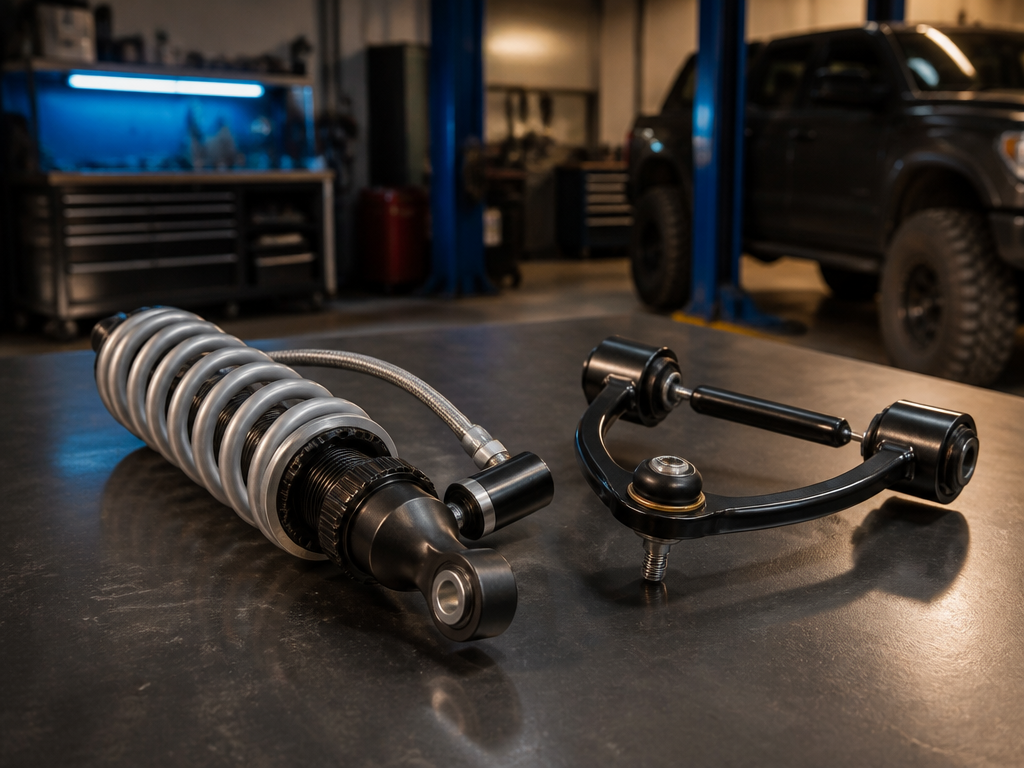
ICON Suspension Systems We Install: Stage 1 Through Stage 8
The stages are cumulative packages, not lift heights. Each one adds a named component that does a specific job — which is exactly why the system is easy to buy correctly.
2.5 Series Front Coilovers
Front 2.5-series coilovers with vehicle-specific valving and a usable ride-height range. The biggest single improvement available to an IFS truck, and a real step beyond leveling kit territory because you gain damping control, not just height.
Coilovers + Rear Shocks + UCAs
Adds Aluminum Series rear shocks so the back end matches the front, plus tubular Delta Joint upper control arms to restore alignment geometry and clearance at height. This is where most owners should land.
Remote Reservoirs & Rear Packs
Remote-reservoir coilovers with CDCV compression adjusters, plus a rear leaf pack or add-a-pack to fix sag and carry load. The tier for trucks that see real dirt or carry weight regularly.
3.0 Series & Long Travel
3.0-body shocks, bypass options, and extended-travel geometry. Genuine high-speed desert capability, and where an ICON build crosses into long-travel suspension territory with fabrication to match.
The Delta Joint Advantage
ICON's tubular upper control arms use a sealed, greasable high-misalignment joint instead of a uniball. You get most of the articulation with ball-joint durability and none of the squeaking and grit-driven wear that make uniballs miserable on a street-driven Houston truck.
Rebuildable and Revalvable
2.5-series shocks can be disassembled, resealed, refilled, and revalved. When you add a bumper, a tent, or bigger tires, the damping can be re-tuned to match instead of replaced. That changes the long-term math considerably.
Buy the Stage You Need
Because the stages are additive, you can start at Stage 1 and grow. We would rather sell you Stage 2 today and Stage 4 in two years than talk you into a system your truck does not use.
Signs Your IFS Truck Needs an ICON Coilover System
Tacoma, 4Runner, Tundra, and GM 1500 owners describe the same handful of symptoms. Each one points at front-end damping rather than lift height.
The Front End Crashes and Bottoms
Hit a dip at speed and the front packs up, tops out, or bottoms hard. Factory struts run out of travel and damping quickly, and no spring or spacer fixes what is fundamentally a damper problem.
It Nose-Dives Under Braking and Wallows in Corners
Soft, underdamped factory valving lets weight transfer happen too fast. A properly valved coilover controls that motion without making the ride harsh — the two are not opposites.
You Added Weight Up Front
A steel bumper, winch, or skid plates and the front sits low and rides worse. This is the single most common reason an owner ends up on coilovers — the correct fix is spring rate matched to the new weight, plus wheel and tire fitment that suits the finished truck.
You Want Height Without Ruining the Ride
Cranked torsion bars or tall spacers get the height and destroy the geometry and down-travel. A coilover with correct spring rate achieves the stance and improves the ride at the same time.
And the honest tradeoffs. ICON costs meaningfully more than a leveling kit for the same visual result. If your only goal is clearing a slightly bigger tire on a truck that never leaves pavement, the money is not well spent here and we will say so.
Coilovers are also not a magic height solution. Winding preload up to chase lift costs down-travel and stiffens the ride — the opposite of why you bought them. Getting real lift with good ride quality means the correct spring rate for your front-end weight, which is a spec conversation, not a turn of a collar.
They need service. A rebuildable shock is an advantage only if it actually gets rebuilt, and a hard-used truck will want attention sooner than an owner expects. And on independent-front trucks there is a hard ceiling on travel that no shock overcomes — past a point, more capability means long travel and fabrication, not a taller coilover.
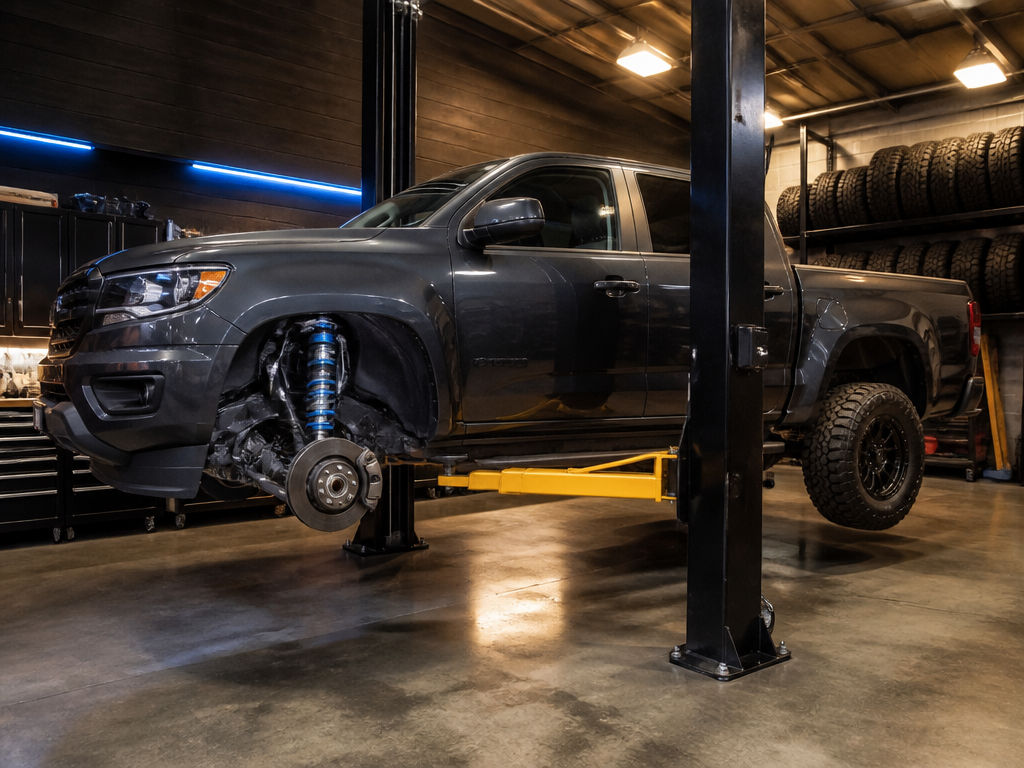
How to Choose the Right ICON Stage — A Houston Truck Owner's Guide
Four questions decide the stage. We ask them before opening a catalog, because the answers usually point somewhere different than the owner expected.
What Is Bolted to the Front of the Truck?
A steel bumper and winch can add well over a hundred pounds ahead of the axle line, and that changes the spring rate you need — not the stage. Getting this wrong is the number one cause of a coilover build that sits right and rides badly.
Pavement, Gravel, or Real Dirt?
A commuter that sees the occasional forest road is beautifully served by Stage 2. A truck that actually runs washboard and whoops at speed justifies remote reservoirs and adjusters. Most trucks are honestly the first case.
Does the Rear Sag or Carry Load?
Bed weight, a camper shell, a rooftop tent, or towing all push you toward the stages that include a rear pack. Fixing the front and ignoring a sagging rear leaves the truck unbalanced and looking wrong.
Is This the Finished Truck?
If armor and a tent are coming next year, we spec for the finished weight now. Because ICON stages are additive, building in the right order saves real money — the wrong order means buying springs twice.
Cross-shopping is fair and we encourage it. Fox is the value-and-fitment champion and what we install most overall; King is the boutique, fully rebuildable top tier. ICON's edge is the vehicle-specific staged system — the whole front end engineered as one package for your exact platform. On an IFS truck, that is usually our first recommendation.
ICON Vehicle Dynamics Pricing in Houston, TX
Parts and labor included in the ranges shown. Every install includes a full alignment, ride-height setting, and a road test. Because the stages are additive, starting lower and adding later is a legitimate plan rather than a compromise.
Front Coilovers
- 2.5 series front coilovers
- Vehicle-specific valving
- 0"–3" adjustable front height
- Spring rate matched to your truck
- Full alignment included
Balanced System
- Front coilovers + rear shocks
- Tubular Delta Joint UCAs
- Front and rear damping matched
- 33"–35" tire fitment typical
- Alignment & ride-height set
Reservoirs & Rear Pack
- Remote-reservoir coilovers
- CDCV compression adjusters
- Rear leaf pack or add-a-pack
- Load capacity restored
- Setup & road-test tuning
3.0 / Long Travel
- 3.0-body shocks & bypasses
- Extended-travel geometry
- Custom fabrication as required
- True high-speed dirt capability
- Full setup & tuning
What moves the number: reservoirs and adjusters are the biggest lever — the same stage with remote-reservoir coilovers and CDCV can shift the quote substantially. After that: whether tubular upper control arms are included, whether the rear needs a leaf pack rather than just shocks, front-end armor that changes the spring rate we spec, tires and wheels bought at the same time, and removal of a previous lift or cranked torsion bars before we start.
ICON Coilover Technical Guide — 2.5 Series, Delta Joint & Terms
The vocabulary that comes up in an ICON consult, defined plainly. If a shop cannot explain these, they are selling part numbers rather than suspension.
| Term | What It Means, and Why It Matters on Your Truck |
|---|---|
| Coilover | A shock and coil spring combined into one assembly with adjustable spring preload. Replaces the factory strut and gives you both real damping control and a ride-height range — which a spacer over a factory strut cannot do. |
| 2.5 series | The shock body diameter in inches. A larger body holds more oil, sheds heat better, and resists fade under sustained abuse. On a Texas summer highway that heat capacity is the difference between consistent damping and a shock that goes soft. |
| IR vs RR | Internal Reservoir versus Remote Reservoir. IR keeps everything in the shock body — simpler and cheaper. RR adds a separate oil reservoir for more capacity and cooling, and is where compression adjusters usually live. |
| CDCV | Compression Damping Control Valve — ICON's external adjuster for compression damping. Lets us firm up the truck for towing or soften it for broken pavement without disassembling anything. |
| Delta Joint | ICON's sealed, greasable high-misalignment upper control arm pivot. Most of a uniball's articulation with ball-joint durability and no squeak — the right compromise for a street-driven truck that also wheels. |
| Spring rate | How much force it takes to compress the spring one inch. Must match what the front of the truck actually weighs, armor included. The most commonly mis-spec'd item in a coilover build, and the usual cause of a truck that sits right but rides badly. |
| Preload | Compressing the spring at rest to raise ride height. Some is normal; using it to chase inches costs down-travel and harshens the ride. Height should come from correct spring rate, not from winding the collar up. |
| Down-travel | How far the suspension can droop below ride height. It is what keeps a tire on the ground over a dip. Cranked-up torsion bars and over-preloaded coilovers both sacrifice it, which is why the truck skips instead of tracking. |
ICON Suspension by Platform — Tacoma, 4Runner, Tundra & GM 1500
ICON's engineering centers on independent-front trucks and SUVs, and that focus shows in how well the vehicle-specific valving suits each platform.
Toyota Tacoma
Probably ICON's most refined application, and the platform where the stage system shines. Front coilovers alone transform a Tacoma; add a rear pack and the truck finally carries weight without sagging. A natural path for Tacoma builds.
Toyota 4Runner
The other Toyota platform ICON has genuinely dialed. Coilovers plus rear shocks fix the factory float and the nose-dive, and it stays comfortable for a family vehicle. Common on 4Runner builds heading toward overlanding weight.
Tundra & GM 1500
Half-ton trucks with real front-end weight benefit enormously from correct spring rate and 2.5 damping. Proven on Tundra and on GM 1500 trucks where owners want composure rather than height.
Ford, Ram & Bronco
ICON covers F-150, Ram 1500, Raptor, and Bronco applications well. The mid-size trucks are covered too — Colorado and Canyon, Ranger, and Frontier all behave much like the Tacoma does, where front coilovers do most of the work. Same for the FJ Cruiser, which shares the 4Runner platform outright. On solid-axle heavy trucks the catalog is thinner — that is where we usually point owners toward a brand built specifically around those platforms instead.
6 ICON Coilover Mistakes Houston Shops Make — And How We Do It Differently
Coilovers are less forgiving of a lazy install than a bolt-in lift. These are the six failures we see most on trucks that come to us afterward.
Ignoring front-end weight when specing spring rate
A truck with a steel bumper and winch gets the standard spring because that is what the catalog listed. It sits low, blows through travel, and rides worse than stock. The owner blames the coilover.
Chasing lift with preload
Winding the collar up to hit a height number. It works visually and destroys down-travel, so the truck rides stiff and skips over dips instead of tracking through them.
Front coilovers with an untouched rear
The front gets sorted, the sagging rear stays. The truck looks nose-high, the balance is wrong, and the rear end still crashes over the same bumps the front now absorbs.
Skipping upper control arms at height
Past a couple of inches the factory arm runs out of ball joint angle and alignment range. Camber cannot be set correctly, the joint binds, and tires wear on the inside edge within a few thousand miles.
Leaving the adjusters at factory default
A shock with CDCV compression adjustment installed and never touched. The owner paid for tunability and drove away with a generic setting that suits no one in particular.
No ride-height measurement or documentation
Nothing recorded, so nobody can tell later whether the truck settled, a spring sagged, or the alignment drifted. Every future diagnosis starts from guesswork.
ICON Coilovers in Houston, TX — Tuned for Slab Highways and Texas Dirt
A Houston Tacoma or 4Runner spends the overwhelming majority of its life on jointed concrete — I-10, 290, the Beltway — and that is a surprisingly demanding surface for a factory strut. The joints arrive at a regular frequency, and an underdamped front end starts to oscillate with them, which owners describe as the truck feeling busy or nervous at highway speed. Correctly valved coilovers settle that down more than any other single change.
Heat is the second Houston-specific factor. August pavement is brutal on shock oil, and a small-body damper working hard on a hot afternoon fades. Larger 2.5-series bodies and the reservoir options exist for exactly that reason — they hold more oil and shed heat, so damping stays consistent instead of going vague by the end of a long drive.
The third thing is what these trucks are actually built for around here. The good dirt is a drive away — the Hill Country, the piney woods north of Conroe, the sand and beach runs down the coast — which means a Houston overland truck racks up long highway miles to get to short technical sections. That is a genuinely hard combination to tune for, and it is where an adjustable, revalvable shock earns its money: firm enough to stay composed loaded on the highway, compliant enough to work once you air down.
And these trucks carry weight. Roof tents, drawers, bumpers, and recovery gear are the norm rather than the exception, and that weight is why we start every consult by asking what is bolted to the truck rather than what stage you want.
Jointed Concrete Highways
Regular-frequency slab joints make an underdamped front end oscillate. Correct valving is what stops the nervous, busy feeling at speed.
August Heat on Shock Oil
Texas summer fades small dampers. The 2.5 body and reservoir options hold oil temperature and keep damping consistent.
Long Haul, Short Trail
Hours of highway to reach the Hill Country or the coast. Adjustable damping covers both ends of that trip without compromise.
How We Install and Tune Your ICON Coilover System
Five steps, and the tuning at the end is the part that separates a coilover install from a parts swap. Same sequence as our wider build process.
Consult & Weigh
We look at what the truck carries now and what is planned, and measure current ride height before anything is ordered.
Spec the Stage
Stage, spring rate, reservoir and adjuster options chosen against your front-end weight, rear load, and how you actually drive.
Install & Set Height
Coilovers, arms, and rear components go in, preload set within proper range, and ride height measured and documented.
Align & Tune
Full alignment, then a real road test where the compression adjusters get dialed for your weight and terrain.
Re-Check & Revisit
Back after break-in to re-measure height, re-check alignment, and fine-tune the settings once the springs have settled.
What Houston Tacoma and 4Runner Owners Are Saying
ICON Vehicle Dynamics Questions, Answered
ICON Coilover Installs Across Greater Houston, TX
We spec, install, and tune ICON systems for Tacoma, 4Runner, Tundra, and half-ton owners from every corner of the metro. Wherever you drive in from, odds are we have already built one from your zip code.
Brands We Trust
We are not loyal to a logo. We are loyal to putting the right system under your truck — which means carrying brands that are genuinely the best at different jobs.

The ride-quality benchmark for Ram HD and Super Duty, with valving developed per application. Where we point heavy solid-axle diesel owners.

The deepest application catalog in the premium tier, Fox shocks spec'd in, and real 4–8 inch lift without wrecking the ride.

The broadest fitment in the business and the value-to-performance sweet spot. The shock we install more than any other.

Fully rebuildable and race-bred. The no-compromise choice when you want the highest ceiling and plan to revalve over time.

5100s and 6112s that deliver a genuine step up from factory without premium pricing. A sensible entry point on a stock-height truck.