BDS Suspension Lift Kits in Houston, TX
BDS is the kit we recommend to more Houston truck owners than any other brand — the deepest application catalog in the premium tier, Fox shocks engineered into the kits, and a warranty with no fine print. It is how you get real lift height and larger tires without the ride falling apart.
BDS Lift Kits Deliver Real Height Without Wrecking the Ride
If a customer walks in wanting a lifted truck and has not already decided on a brand, BDS is what we recommend more often than anything else on the shelf. That is not a distribution deal talking. It is the honest result of watching which kits still ride well three years and forty thousand Houston miles later.
BDS has been building suspension in Coldwater, Michigan since 1996, and the thing they do better than anyone is breadth without dilution. The application catalog across Ford, Ram, Chevy, GMC, Toyota, and Jeep is the deepest in the premium tier, and — this is the part that matters — the individual applications are actually developed rather than adapted from a neighboring fitment. A BDS kit for your truck was engineered for your truck.
The shock package is the second reason. Most BDS kits ship with Fox shocks designed into the system rather than a house-brand damper thrown in to hit a price. On a lifted truck the shock is what determines whether the thing rides well or floats and crashes, so a kit that gets this right from the box is worth real money.
Third is the warranty, which has no fine print — no clause voiding coverage because you took the truck off pavement, which is a genuinely unusual thing in this industry. Put those together and BDS is the best value-to-quality ratio available for a 4 to 8 inch lift kit that has to survive being a daily driver.
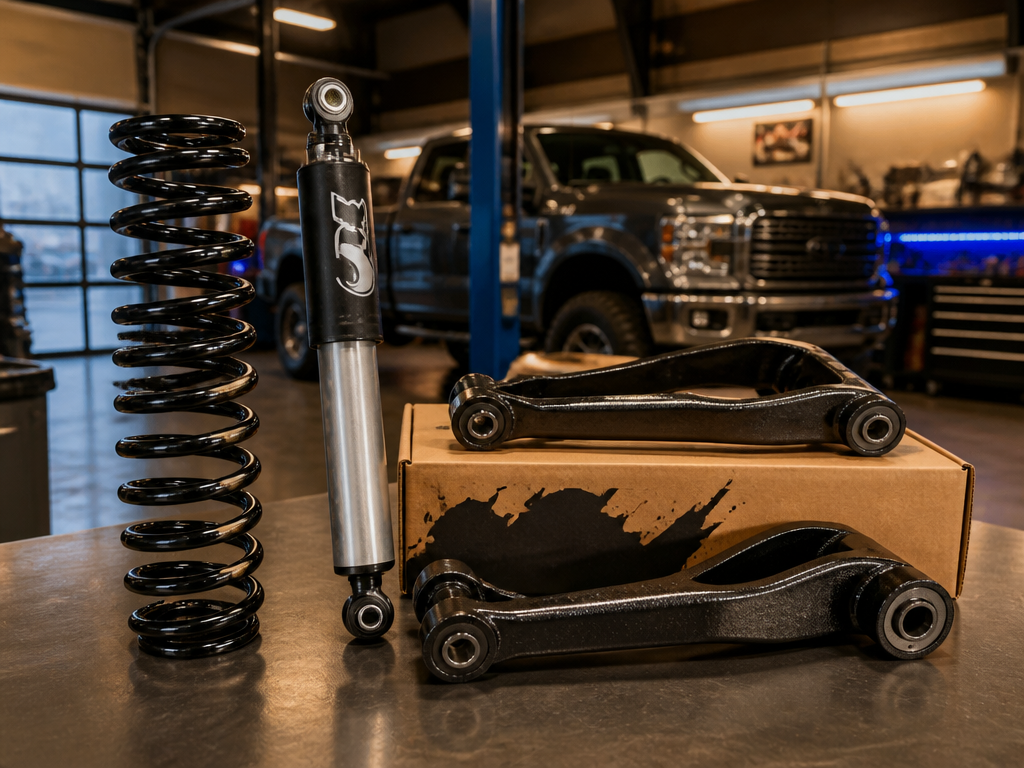
BDS Lift Kits We Install: Box Kits, Radius Arm & 4-Link Systems
BDS builds across the whole range, from a mild level to a full coilover conversion. The tiers are separated by how much geometry correction the height actually demands.
BDS Leveling Kits
Two to two-and-a-half inches up front to kill the factory rake and clear a 33 or 34-inch tire. Coil spacers or replacement coils depending on platform, and a big step up in quality from a generic leveling kit because the geometry impact is actually accounted for.
BDS Box Kits, 4″–6″
The complete bolt-in system most owners land on. Coils or brackets, upper control arms where the platform needs them, extended brake lines, and Fox 2.0 shocks in the box. Clears 35s and often 37s. This is the sweet spot of the entire brand.
BDS Radius Arm Kits
For solid-axle trucks going tall enough that factory arms can no longer hold correct caster and pinion angle. Replaces the arms outright to restore geometry at height — proper long-arm and radius-arm geometry rather than a drop bracket band-aid.
Coilover 4-Link Systems
A full link-geometry conversion with coilovers replacing the factory arm setup entirely. Maximum articulation and ride quality at serious height. Fabrication-adjacent work, and the tier where a diesel truck lift stops being a bolt-on job.
Fox in the Box, NX2 as the Value Option
BDS has been part of the Fox Factory family since 2014, so Fox 2.0s are spec'd into kits as the engineered damper. BDS's own NX2 nitrogen series covers the value end, and Fox 2.5 with a reservoir is the step up on many applications. We tell you which damper is in the kit before you buy.
The Zone Offroad Question
Zone shares ownership with BDS and sits as the budget line. We would rather explain that than have you find out later. Zone is fine on a lightly used truck; if yours is daily-driven, tows, or is going on bigger tires, the step up to BDS is the one we recommend.
Recoil Traction Bars
On lifted trucks making real torque, axle wrap under load turns into wheel hop and driveline vibration. BDS Recoil bars address it directly, and they are a common add on lifted diesels that tow or run larger tires.
Signs You Need a BDS Lift Kit — and What It Unlocks
Most owners arrive with a goal rather than a symptom. These are the four goals a BDS system actually serves, and what each one really requires.
You Want 35s or 37s to Actually Fit
Tire clearance is the number one reason trucks get lifted, and it is the thing BDS does most cleanly. A 4 to 6 inch kit plus the right wheel and tire package gets you there without permanent trimming or rubbing at full lock.
Your Cheap Lift Rides Terribly
Spacers on tired factory shocks, no geometry correction, and a truck that crashes over every joint. This is the most common trade-in we see, and replacing it with a designed system is a night-and-day change.
You Need Clearance for Real Trail Use
Approach and breakover angle, and the articulation to keep tires planted. A full BDS system with the right shock package makes a truck genuinely capable rather than just taller.
You Tow and Still Want the Truck Lifted
The combination most brands handle badly. Correct spring rate, Fox damping, and traction bars where needed let a lifted truck still pull a trailer without wallowing.
And the honest tradeoffs. Every inch of lift costs you something. Center of gravity rises and the truck leans more in corners. Fuel economy drops, mostly from the tires rather than the lift itself. Driveline angles change, and past about 6 inches you are usually looking at driveshaft work to avoid vibration.
Larger tires also mean your speedometer reads wrong and your effective gearing gets taller, which on a truck that tows can mean a re-gear to get the drivability back. None of this is a reason not to lift. It is a reason to budget for the whole build rather than the kit price alone.
And BDS will not give you the last few percent of empty-ride compliance that a boutique ride-quality system delivers on a heavy diesel. If that specific quality is the goal and budget allows, we will point you at Carli instead — that is a different design target, not a better version of the same one.
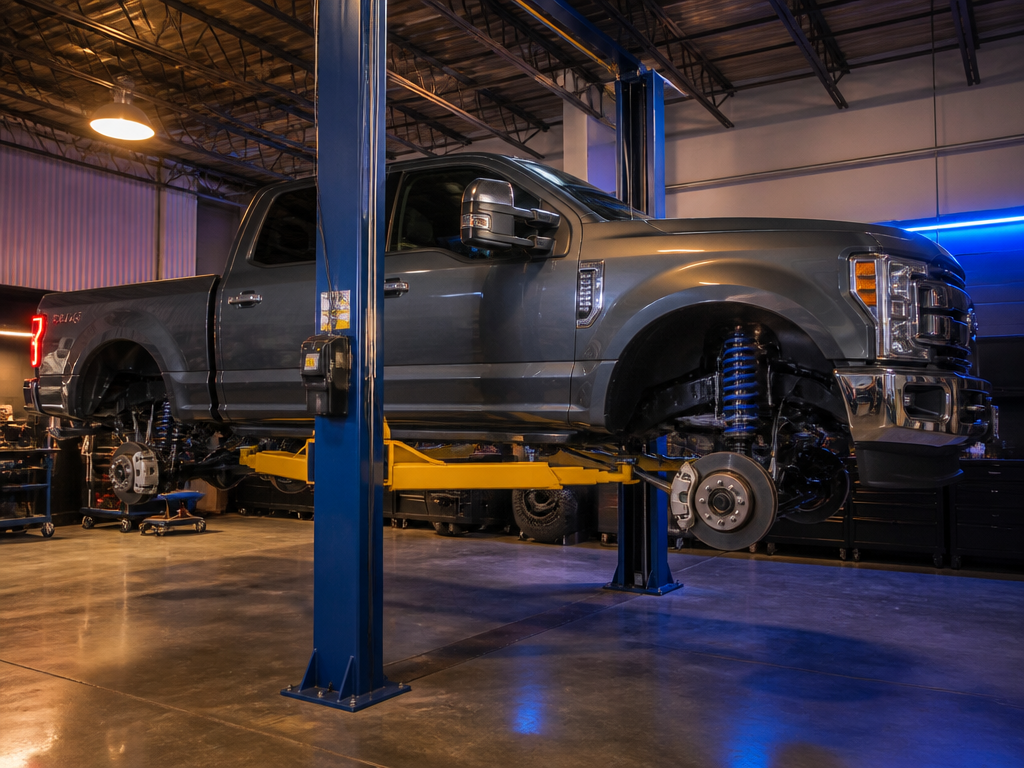
How to Choose the Right BDS Lift Kit — A Houston Truck Owner's Guide
Four questions, asked in this order. Answer them honestly and the kit selects itself — which is why we ask them before anyone opens a catalog.
What Tire Are You Landing On?
This drives lift height more than anything else, and it should be decided first. 33s often need only a level. 35s typically want 4 inches. 37s usually mean 6. Picking a height first and discovering the tire does not fit is the most common expensive mistake.
Highway Miles or Trail Miles?
A commuter that sees gravel wants a moderate lift with Fox 2.0s and correct geometry. A truck that genuinely wheels justifies stepping toward radius arms or a link system. Be honest here — most trucks are the first case and are better served by spending the money on shock quality instead of height.
Do You Tow or Haul?
Towing changes the calculus. Spring rate, traction bars, and shock damping all matter more, and it may argue for less height than you originally wanted. A 4-inch towing truck that works is better than a 6-inch one that porpoises down I-45.
What Is the Whole-Build Budget?
The kit is rarely the whole number. Tires, wheels, alignment, possible driveshaft and gearing work all belong in the plan. We would rather scope the complete build honestly than quote a kit and surprise you twice.
The shortest version: for the large majority of Houston trucks, a 4 to 6 inch BDS box kit with Fox 2.0s on 35s is the configuration that makes owners happiest. Go taller only if a specific, named goal requires it.
BDS Suspension Pricing in Houston, TX
Parts and labor included in the ranges shown. Every install includes a full alignment, torque verification at ride height, and a road test before the truck goes home.
Leveling Kit
- 2"–2.5" front level
- BDS coils or spacers
- 33"–34" tire fitment
- Often same-day install
- Alignment included
4″–6″ Box Kit
- Complete bolt-in system
- Fox 2.0 shocks included
- UCAs & extended brake lines
- 35"–37" tire clearance
- Full alignment & caster correction
4″–6″ with NX2
- Same kit, BDS NX2 damping
- Best cost per inch of lift
- 35" tire fitment typical
- Upgrade path to Fox later
- Alignment included
Radius Arm / 4-Link
- Full geometry correction
- Coilovers or Fox 2.5 reservoir
- 6"–8"+ height
- 37"–40" tire clearance
- Driveline work as required
What moves the number: the shock package is the biggest single lever — the same kit with Fox 2.5 reservoirs instead of NX2 can shift the quote by well over a thousand dollars. After that: whether the platform needs upper control arms, whether height forces driveshaft or brake line work, traction bars on a truck that tows, tires and wheels bought at the same time, and removal of a previous lift if one is already on the truck.
BDS Lift Kit Technical Guide — Terms, Specs & Components
The vocabulary that comes up in a lift quote, defined plainly, so you can tell whether a shop is describing real work or padding an invoice.
| Term | What It Means, and Why It Matters on Your Truck |
|---|---|
| Box kit | A complete bolt-in lift system shipped as one engineered package — springs or brackets, arms, hardware, brake lines, and shocks. The advantage is that every component was validated together instead of assembled from parts that individually looked fine. |
| Radius arm | The longitudinal arm locating a solid front axle fore-aft and setting caster. Lift changes its angle; past roughly 4 to 6 inches, replacement arms are what restore correct geometry rather than compromising it with drop brackets. |
| 4-link conversion | Replacing the factory arm arrangement with a designed four-link geometry plus coilovers. Maximum articulation and control at height. This is fabrication-adjacent work and the top of the BDS range. |
| Upper control arm (UCA) | On independent-front trucks, lift pushes ball joint and camber past factory range. Aftermarket UCAs restore alignment capability and clearance. Required on many platforms above about 2.5 inches. |
| NX2 series | BDS's own nitrogen-charged shock line. A solid value damper that covers the budget end of the catalog, and the component most commonly upgraded to Fox when a customer wants better ride quality. |
| Recoil traction bar | A bar controlling rear axle wrap under torque. On a lifted truck making real power, axle wrap becomes wheel hop and driveline vibration; the bar prevents the axle from rotating against the leaf pack. |
| Pinion angle | The angle of the differential input relative to the driveshaft. Lift changes it, and if it is not corrected the result is vibration at speed and accelerated u-joint wear. A common casualty of cheap installs. |
| Caster | The forward or rearward tilt of the steering axis. Adequate caster gives straight-line stability and self-centering steering. Lift reduces it, and restoring it deliberately is the difference between a truck that tracks and one that wanders. |
BDS Lift Kits by Platform — Ford, Ram, Chevy, Toyota & Jeep
Catalog breadth is BDS's defining advantage. Whatever you drive, there is a good chance there is a properly developed BDS application for it — which is not something most brands can claim.
Ford F-150 & Super Duty
One of the strongest corners of the BDS lineup, from mild levels through radius arm systems on the Super Duty. The half-ton kits ride particularly well with Fox 2.0s, and it is a common path for F-150 builds heading to 35s.
Ram 1500 & HD
Coil-sprung Ram platforms respond very well to a designed BDS system, and the HD radius arm kits are a proven answer at height. A frequent choice on Ram 1500 builds where the owner wants 35s and keeps towing.
Chevy & GMC 1500 / HD
Independent front GM trucks need proper UCAs and correct shock length to lift well, and BDS packages both rather than leaving them as afterthoughts. Common on Silverado builds going to 35s or 37s.
Jeep & Toyota
BDS covers Wrangler and Gladiator well, including long-arm systems at height, and has solid Tacoma and Tundra applications. A dependable option on Wrangler builds where the owner wants a proven bolt-in system.
6 BDS Lift Kit Mistakes Houston Shops Make — And How We Do It Differently
A good kit installed badly is a bad lift. These are the six failures we see most on trucks that come to us for a second opinion.
Toe-and-go instead of a real alignment
A lift changes caster, camber, and thrust angle. Setting toe alone and calling it aligned sends the truck home wandering, and eats the inside edges of expensive new tires within a few thousand miles.
Ignoring driveline angles above 6 inches
Tall lift, factory driveshaft, uncorrected pinion angle. The owner gets a vibration at 65 that no amount of tire balancing will fix, and burns through u-joints chasing it.
Reusing tired factory shocks with new springs
Springs go in, worn dampers stay. The truck rides high and floats, which owners describe as feeling "boaty." The kit gets blamed for something the shocks caused.
Skipping brake lines and bump stops
Stock brake lines at full droop become stretched brake lines, and a missing bump stop extension lets the tire find the fender at full compression. Both are cheap parts and serious problems.
Selling height the customer did not need
An owner wants 35s and gets quoted 6 inches because it sounds better. They end up with driveline work, worse road manners, and more money spent than the goal required.
Torquing bushings at full droop
Everything tightened while the truck hangs on the lift. Every bushing is preloaded against the suspension for the rest of its life, which stiffens the ride and shortens bushing life considerably.
BDS Lift Kits in Houston, TX — Built for Texas Heat and Gulf Coast Roads
A lifted truck in Houston lives a specific life, and it is not the one the marketing photos show. It spends most of its miles on jointed concrete slab — I-10, 288, the Beltway — where a poorly damped lift turns every joint into a hit and the truck develops that floaty, disconnected feeling over undulating pavement. Damping quality matters more here than lift height does, which is exactly why a kit with Fox shocks engineered in is worth the premium over a spacer-and-spring special.
Heat is the second factor and the one most owners underestimate. August pavement temperatures cook shock oil, and a cheap damper that felt acceptable in March goes soft and vague by mid-summer. Larger shock bodies and reservoir options hold up to that, which is why we push people toward the better shock package rather than the taller kit when budget forces a choice.
Then there is water. Gulf Coast humidity, salt air off Galveston Bay, and streets that flood several times a year are hard on hardware, bushings, and any exposed fastener. Kits with properly coated components and correctly torqued, greased hardware survive that. Bargain kits show surface rust on the arms by the second summer.
And the trucks here work. This is a towing city — boats to the coast, equipment trailers out to job sites, goosenecks north past Conroe. A lift that ignores towing behavior is a lift that will disappoint by the first long haul, which is why traction bars and spring rate come up in nearly every consult we do.
Concrete Slab Highways
Jointed concrete rewards damping quality over height. Fox-equipped kits ride markedly better here than spacer lifts on factory shocks.
August Heat on Shock Oil
Texas summer pavement fades cheap dampers. Larger bodies and reservoirs keep the truck composed through the hottest months.
Salt Air & Flood Water
Coastal humidity and repeated standing water punish hardware. Coated components and correctly greased joints are what last here.
How We Install Your BDS Lift Kit
Five steps, and nothing gets ordered until the truck has been on a lift. This is the same sequence as our wider build process.
Consult & Measure
We start from the tire you want, look at what the truck already has, and check for worn components before anything is quoted.
Spec the Kit
Height, shock package, and geometry components chosen against your tire target, tow habits, and budget — quoted as a complete build.
Install & Correct
Kit goes in with brake lines, bump stops, and geometry correction, and every bushed joint torqued at ride height.
Align & Road Test
Full alignment and caster correction, driveline angles verified, then a highway road test before you get the keys.
Re-Torque & Re-Check
Come back after break-in. We re-torque hardware, re-check alignment, and correct anything that settled. Included.
What Houston Truck Owners Are Saying About BDS
BDS Suspension Questions, Answered
BDS Lift Kit Installs Across Greater Houston, TX
We spec, install, and align BDS systems for truck owners from every corner of the metro. Wherever you are driving in from, there is a good chance we have already lifted one from your zip code.
Brands We Trust
We are not loyal to a logo. We are loyal to putting the right system under your truck — which means carrying brands that are genuinely the best at different jobs.

The ride-quality benchmark for Ram HD and Super Duty, with valving developed per application. The step up when empty-truck comfort is the goal.

Race-bred, USA-machined staged systems built around 2.5-series coilovers. Our pick on Tacoma, 4Runner, Tundra, and GM 1500 independent front ends.

The broadest fitment in the business and the damper engineered into most BDS kits. The shock we install more than any other.

Fully rebuildable and race-bred. The no-compromise choice when you want the highest ceiling and plan to revalve over time.

5100s and 6112s that deliver a genuine step up from factory without premium pricing. A sensible pairing on lighter builds.