Carli Suspension Installer in Houston, TX
Carli is the ride-quality benchmark for heavy trucks — and the only suspension brand we install where the shock valving was developed for your exact truck instead of adapted from a catalog. We spec, install, and set up Carli Backcountry, Pintop, and leveling systems for Ram HD and Ford Super Duty owners who daily their truck and refuse to trade street manners for height.
Carli Suspension Is Built for Ride Quality, Not Lift Height
Here is the thing most people get wrong about Carli: it is not a lift brand. A boutique California outfit that has been at this since 2003, Carli builds suspension systems for one purpose — making a heavy truck ride like something a human being would want to drive every day. The lift is a side effect of doing that correctly, which is why most of their systems land between 2.5 and 4.5 inches and stop there.
The reason we carry it is narrower and more specific than "it's a premium brand." Carli valves its shocks in-house, per application. Not per vehicle class, not per rough weight bracket — per truck. A 2020 Ram 3500 with a gooseneck hitch gets different damping curves than an F-250 that never tows. That is expensive and slow to develop, which is exactly why almost nobody else does it, and it is the entire reason a Carli truck feels the way it does.
Factory HD trucks are sprung for a payload they almost never carry. That is why an empty 2500 skips sideways over expansion joints and beats you up on I-10. Carli attacks that directly with progressive-rate coils and matched valving, so the truck is compliant empty and still composed when it is loaded. It is a different design goal than a conventional full suspension lift, and it is the right one for a truck that gets driven daily.
We will also tell you when it is the wrong answer. If your goal is height and 40-inch tires, Carli is not your brand — that is a conversation about diesel truck lift systems built around clearance instead. We would rather lose the sale than put you in a system that fights what you actually want.
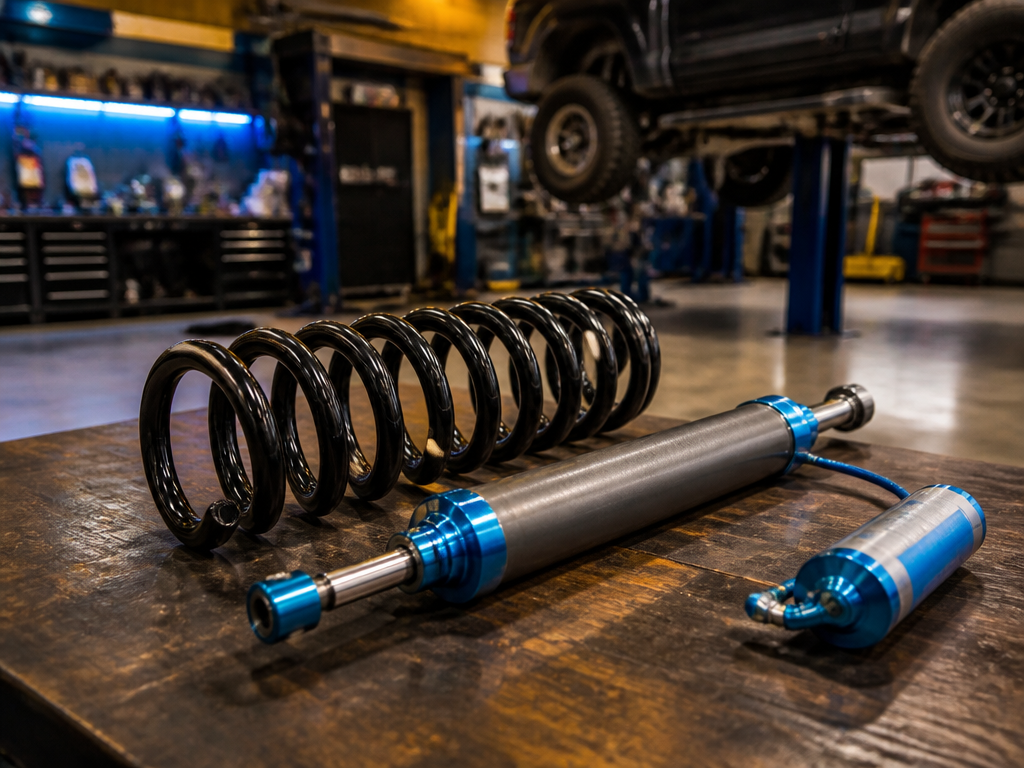
Carli Suspension Systems We Install: Leveling, Backcountry & Pintop
Carli builds in tiers, and the tiers are honest — each step buys a specific, describable improvement rather than a bigger number. Here is what we install most and who each one is actually for.
Carli Leveling System
Carli-spec progressive coils and tuned damping that level the front and fix the empty-truck harshness without touching geometry hard. The right starting point if the truck is mostly street and light trail, and a real step above a spacer-style leveling kit.
Carli Backcountry
The system Carli is known for. Progressive coils, a Deaver-built rear leaf pack, and Carli-valved shocks working together as a designed package. Compliant on broken pavement, controlled on washboard, still composed with a trailer on the ball. This is what most Houston HD owners actually want.
Carli Pintop Coilover
A true front coilover on a Carli pintop mount, combining spring and damper with a real damping range. The pick when the front end carries a winch bumper and you want it dialed for that exact load — a proper coilover installation rather than a spring swap.
3.0 Systems & Long Travel
Carli's Dominator and Unchained territory — 3.0-body shocks, maximum travel, and the most aggressive valving they build. Genuine desert capability on a heavy truck. Rare, expensive, and worth it only if you actually run hard, fast dirt.
The Shock Is the Product
Carli's upper systems are built around King 2.0 and 2.5 bodies carrying Carli-specific valving — not off-the-shelf shocks in a Carli box. Entry tiers use Carli-tuned Bilstein damping, and Fox shows up on some applications. Swap the shock to save money and you have removed the thing you were buying.
The Rear Leaf Pack Matters
On Backcountry systems the rear is a Deaver-built progressive pack, not a stiffer version of stock. It stays supple empty and ramps up as load goes on. That progressive behavior is what lets a Carli truck ride softly without squatting under a gooseneck.
Sold as a System
Coils, shocks, leaf pack, track bar, and arms are engineered against each other. Buying half a Carli system and mixing in parts from elsewhere is the most common way owners end up disappointed with an expensive suspension.
Signs Your HD Truck Needs a Carli Suspension System
Diesel owners rarely walk in asking for suspension by name. They walk in describing symptoms. These are the ones that point at a Carli-shaped answer.
It Beats You Up Empty
The truck rides fine loaded and punishes you the other ninety percent of the time. Expansion joints on the Beltway register as impacts, not bumps. This is the single most common reason a Houston HD owner ends up on a Carli system, and it is a spring-rate problem no shock alone will fix.
It Wanders and Head-Tosses
Side-to-side head toss on broken concrete, and constant small steering corrections at highway speed. Usually a combination of an overwhelmed factory shock, a tired track bar, and geometry that was never corrected after a cheap lift.
It Squats and Porpoises Under Load
Hook up the gooseneck and the rear drops, the headlights point at the trees, and the whole truck oscillates over every dip. A progressive rear pack and correctly valved shocks fix the oscillation, not just the ride height.
You Are Chasing Fixes One Part at a Time
New shocks helped a little. A steering stabilizer masked it for a while. Airbags fixed the squat and made the empty ride worse. This is the pattern that ends with owners spending more in pieces than a designed system would have cost.
And the honest tradeoffs. Carli is the most expensive way to solve this problem — meaningfully more than a conventional lift that gets you similar height. You are buying ride quality and engineering, not inches, and if what you want is inches the money is misallocated.
Tire clearance is limited by design. Most Carli systems put you comfortably on 35s and sometimes 37s with the right wheel offset, but they are not the path to 40s. Parts availability on the boutique tiers can also mean a wait, because these are not mass-produced catalog items.
And it demands a correct install. A Carli system torqued at full droop instead of ride height, or bolted to worn ball joints and a tired track bar, will not deliver what you paid for — which is precisely why we treat the setup as the product rather than the box.
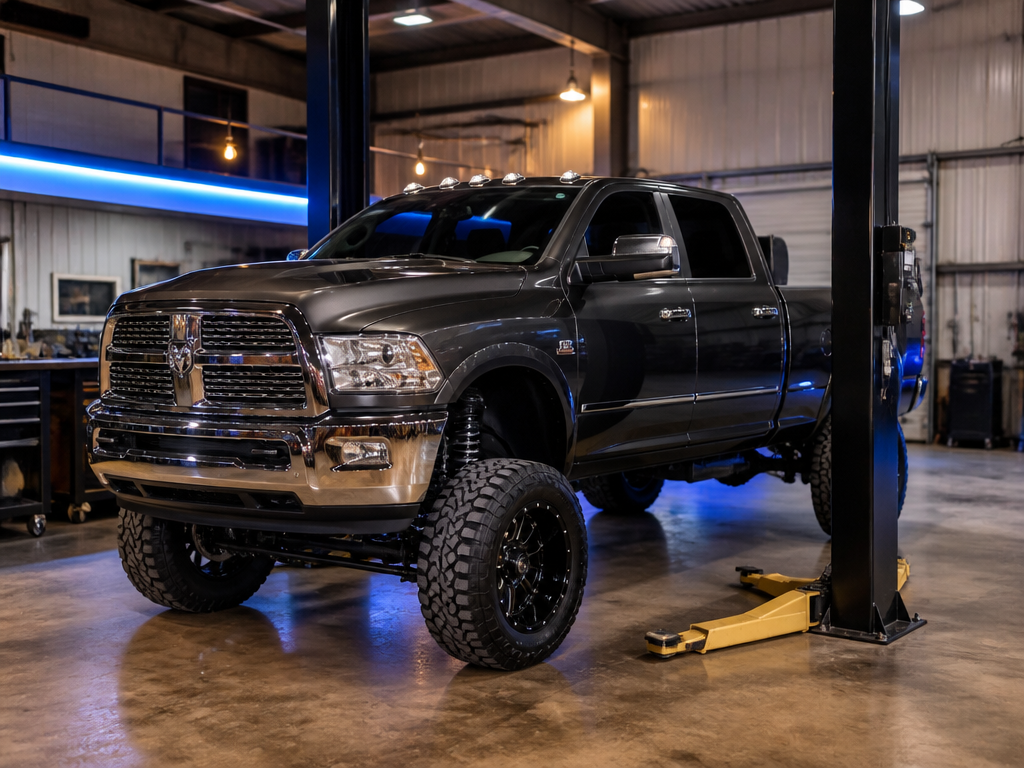
How to Choose the Right Carli System — A Houston Diesel Owner's Guide
Four questions decide the package. We ask them at the consult, in this order, before anyone talks about part numbers.
How Do You Actually Load It?
Empty commuter, bumper-pull occasionally, gooseneck every week, or a slide-in camper that lives on the truck? This drives the rear pack choice more than anything else. A truck that tows heavy weekly and one that tows twice a year want genuinely different rear setups.
What Is the Front End Carrying?
A steel bumper and winch adds real weight ahead of the axle and changes the spring rate you need. If that is on the truck or coming later, we spec for the finished state — which is often what pushes an owner toward the Pintop coilover instead of a coil-and-shock package.
What Tire Are You Landing On?
35s are comfortable Carli territory. 37s are achievable on most HD platforms with attention to offset and trimming. If the honest answer is 40s, we should be having a different conversation about a taller conventional system.
Highway Miles or Dirt Miles?
A truck living on Houston pavement and gravel county roads is served beautifully by a Backcountry system. A truck that genuinely runs fast, rough dirt is the rare case that justifies stepping up to 3.0 territory. Most owners are honestly in the first group.
The shortest version: if you daily a heavy truck, tow real weight, and the empty ride is what bothers you, Backcountry is the answer roughly eight times out of ten. The other two are the owner who only needs the front fixed, and the owner who genuinely races the thing.
Carli Suspension Pricing in Houston, TX
Parts and labor included in the ranges shown. Every install includes a full alignment, torque verification at ride height, and a road test. Carli sits above conventional lift pricing — these are boutique, application-specific systems, and we would rather show you that plainly than surprise you.
Leveling System
- Carli progressive front coils
- Carli-tuned damping
- Front leveled, empty ride fixed
- 35" tire fitment typical
- Full alignment included
Backcountry
- Progressive coils + Deaver rear pack
- Carli-valved King 2.0 shocks
- Track bar & geometry correction
- 2.5"–3.5" net lift typical
- Tow-and-daily balance dialed
Pintop & 2.5 Systems
- Front coilovers on Carli pintop mount
- King 2.5 with Carli valving
- Spec'd for winch-bumper weight
- Ride height adjustability
- Setup & road-test tuning
3.0 / Long Travel
- 3.0-body shocks, maximum travel
- Dominator / Unchained territory
- Custom fabrication as required
- Genuine high-speed dirt capability
- Full setup & tuning
What moves the number: worn steering and front-end components found once we are in there (ball joints, track bar, tie rod ends) are the most common adder, and on a high-mileage HD truck they are common enough that we budget for the possibility up front. Beyond that: whether the rear pack is included or the truck keeps its factory leaves, whether the front end carries a winch bumper, tire and wheel changes bought at the same time, and whether the truck is coming off a previous lift that has to come apart first.
Carli Suspension Technical Guide — Valving, Spring Rates & Terms
The vocabulary that comes up in a Carli consult, defined plainly. If a shop cannot explain these, they should not be installing your system.
| Term | What It Means, and Why It Matters on Your Truck |
|---|---|
| Progressive-rate coil | A spring whose rate increases as it compresses, rather than staying constant. Soft in the first few inches so the empty truck rides well; stiff deeper in travel so it does not bottom out loaded. This is the core of how Carli gets comfort without sacrificing capability. |
| Valving | The internal shim stack that controls how fast oil moves through the shock piston, which determines damping. Carli develops these curves per application in-house. It is the single largest reason a Carli truck feels different from the same truck on generic shocks. |
| Deaver pack | A multi-leaf rear spring pack built by Deaver to Carli's spec. Progressive by design — compliant unloaded, ramping up under weight. Replaces the factory pack rather than adding to it. |
| Pintop | Carli's coilover top-mount design that lets a full coilover fit the factory HD front end without cutting. Enables real ride-height adjustment and a wider damping range than a coil-and-shock setup. |
| Track bar | The lateral link locating the solid front axle under the truck. Lifting shifts axle centerline and changes its angle; a worn or uncorrected track bar is a leading cause of head toss and wander on lifted HD trucks. |
| Radius arms | The longitudinal arms controlling front axle fore-aft position and caster on Ram HD. Lift changes caster angle; correcting it is what keeps the steering from feeling vague or darty afterward. |
| Ride height torque | Tightening suspension bushings with the truck's weight on the wheels rather than hanging at full droop. Torque at droop and the bushings are permanently preloaded, which stiffens the ride and shortens bushing life. Skipping this is the most common cheap-install shortcut. |
| Caster | The forward or rearward tilt of the steering axis. Enough caster gives straight-line stability and self-centering; too little produces wander. Lift reduces it, and it must be restored deliberately. |
Carli Suspension by Platform — Ram HD & Ford Super Duty
Carli's catalog is deliberately narrow. It lives on solid-front-axle heavy trucks, and that focus is a large part of why the systems work as well as they do. Here is where it fits and where it does not.
Ram 2500 & 3500
Carli's home turf, and the coil-sprung Ram HD front end is what the brand was effectively built around. The deepest catalog, the most refined valving, and the platform where the difference between Carli and everything else is most obvious. Lighter-duty Ram platform work follows a different path.
Ford F-250 & F-350 Super Duty
The other platform Carli genuinely specializes in. Super Duty owners running Carli usually come to us after fighting the factory ride for years. Note that half-ton Ford truck builds are a different suspension conversation entirely — Carli is not the answer there.
Ram 1500 & Others
Carli has expanded into some lighter and independent-front applications, but the catalog is thinner and the value case is weaker. On these platforms we will usually point you at a brand whose engineering is genuinely centered on your truck instead.
Where We Say No
Jeeps, mid-size trucks, and IFS SUVs are not Carli territory, and no amount of wanting it changes that. We would rather put you on the right brand for your platform than sell a badge that does not fit the truck.
6 Carli Install Mistakes Houston Shops Make — And How We Do It Differently
A Carli system is only as good as the hands that install it. These are the five failures we see most often on trucks that come to us for a second opinion.
Torquing bushings at full droop
The truck is hanging on the lift, everything gets tightened, and it comes down. Every bushing in the system is now permanently preloaded and fighting the suspension through its whole range. The owner paid for compliance and got harshness.
Bolting a new system to a worn front end
New coils and shocks onto tired ball joints, a sloppy track bar, and worn tie rod ends. The truck still wanders, the owner blames the suspension, and the money is wasted on a foundation that was never inspected.
Substituting the shock to hit a price
A cheaper shock swapped into an otherwise-Carli system because the quote looked high. The valving was the product. What is left is an expensive spring kit that rides like a compromise.
Skipping caster and geometry correction
Lift goes in, alignment gets a toe adjustment, truck goes home darty and vague at 70 mph. Caster was never restored and the track bar angle was never addressed.
No re-torque, no follow-up
Fresh suspension settles and fasteners relax over the first few hundred miles. Shops that hand the keys over and never see the truck again are leaving that to chance on a five-figure system.
Selling Carli to someone who wanted height
An owner asks for a big lift and 40s, hears "Carli is the best," and spends premium money on a system designed around a completely different goal. Everyone involved ends up unhappy.
Carli Suspension in Houston, TX — Built for Concrete Slabs and Tow Miles
Houston is a uniquely bad place to daily a factory-sprung heavy truck, and it is not because of off-road terrain. It is the concrete. Long stretches of I-10, 288, and the Beltway are jointed concrete slab, and a stiff HD truck turns every one of those joints into a hit that travels straight up the steering column. Owners describe it as the truck skipping sideways when the pavement is broken. That is a spring-rate and damping problem, and it is exactly what a progressive coil with matched valving is built to absorb.
The second half is the load cycle. Gulf Coast HD trucks tow — boats to Galveston and Matagorda, equipment trailers out to job sites in Katy and Baytown, goosenecks to properties up past Conroe — and then spend the week empty on a commute. That empty-then-loaded-then-empty cycle is the hardest thing to spring for, and it is where a single-rate replacement spring always disappoints in one direction or the other.
Then there is the heat. Ninety-degree pavement in August is brutal on shock oil, and a shock that fades on a long tow is a shock that stops controlling the trailer. Carli's larger-body shocks and the reservoir options on the upper tiers exist for exactly this — heat capacity so damping stays consistent on the third hour of a tow rather than going soft when you need it.
If you are earlier in the process and still deciding whether to lift at all, it is worth reading what lifting a diesel truck actually involves before you spend anything — the decisions that come before the brand matter more than the brand.
Concrete Slab Highways
Jointed concrete on I-10, 288, and the Beltway is the number one complaint we hear from HD owners. Progressive coils and correct low-speed damping are what quiet it down.
Tow-Then-Empty Cycling
Boats to Galveston, goosenecks to Conroe, empty commutes in between. A progressive rear pack handles both ends of that cycle where a single-rate spring cannot.
Gulf Coast Heat
August pavement cooks shock oil. Bigger bodies and reservoirs keep damping consistent deep into a long tow instead of fading when it matters.
How We Install and Set Up Your Carli Suspension System
Five steps, and the two that matter most are the ones cheap installs skip. This mirrors our wider build process — nothing gets ordered before the truck is on a lift.
Consult & Inspect
Truck goes on the lift. We look at ball joints, track bar, tie rods, and what the front end is carrying, and we ask how you actually load it.
Spec the System
Tier, spring rate, rear pack, and shock package chosen against your load profile and tire target — then quoted as a complete system.
Install & Correct
System goes in, geometry gets corrected, and every bushed joint is final-torqued at ride height with the weight on the wheels.
Align & Road Test
Full post-lift alignment with caster restored, then a real road test on the highway — not a lap around the block.
Re-Torque & Re-Check
You come back after break-in. We re-torque, re-check the alignment, and adjust anything that settled. Included.
What Houston Diesel Owners Are Saying About Carli
Carli Suspension Questions, Answered
Carli Suspension Installs Across Greater Houston, TX
We spec and install Carli systems for diesel owners from every corner of the metro. Wherever you tow from, there is a good chance we have already built a truck out of your zip code.
Brands We Trust
We are not loyal to a logo. We are loyal to putting the right system under your truck — which means carrying brands that are genuinely the best at different jobs.

The deepest application catalog in the premium tier, Fox shocks spec'd in, and real 4–8 inch lift without wrecking the ride. Where most owners should start.

Race-bred, USA-machined staged systems built around 2.5-series coilovers. Our pick on Tacoma, 4Runner, Tundra, and GM 1500 independent front ends.

Fully rebuildable, race-bred, and the shock under Carli's own upper systems. The no-compromise choice when you plan to revalve over time.

The broadest fitment in the business and the value-to-performance sweet spot. The shock we install most across street-and-trail builds.

5100s and 6112s that deliver a genuine step up from factory without premium pricing. Also the damping behind Carli's entry tiers.